


Aluminium Cabinets vs Plywood: Which Material Wins for Singapore Kitchens in 2026?
Aluminium cabinets offer superior moisture resistance and a lifespan exceeding 20 years, making them particularly well-suited to Singapore’s humid tropical climate. Plywood cabinets, when properly sealed and maintained, can last 15 to 20 years and remain a popular choice for homeowners who prioritise warmth, customisation, and a lower upfront cost.
Key Takeaways
- Aluminium cabinets generally last longer than plywood in Singapore’s high-humidity environment, with a lifespan of 20+ years versus 15 to 20 years for well-maintained plywood.
- Aluminium kitchen systems can be priced 30 to 40% cheaper than plywood kitchens depending on specifications, according to Ujwal Kitchens (2025).
- Plywood offers greater design flexibility and a warmer aesthetic, which suits homeowners seeking a traditional or natural look.
- Both materials have trade-offs in cost, maintenance, and environmental impact that are worth weighing carefully before committing.
- Singapore’s climate makes moisture resistance a critical factor; aluminium holds a clear edge here.
- T Se7en Alucraft brings over 30 years of carpentry experience to help you choose and build the right cabinet solution for your home.
The global kitchen cabinets market was valued at USD 107.86 billion in 2025 and is projected to reach USD 218.23 billion by 2034, growing at a compound annual growth rate of 8.26% (Fortune Business Insights, 2025). Within this expanding market, the debate between aluminium cabinets vs plywood is becoming increasingly relevant for Singapore homeowners planning renovations in 2026. This article breaks down every angle of that comparison so you can make a genuinely informed decision.
What Aluminium and Plywood Cabinets Actually Are
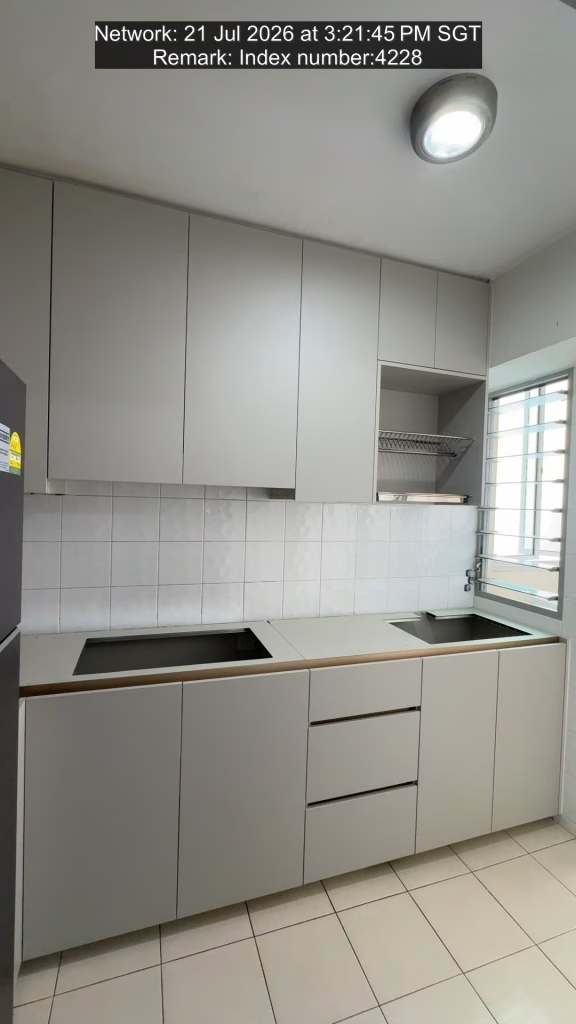
Before comparing the two materials, it helps to understand exactly what each one involves in a Singapore context.
Aluminium cabinets are constructed from extruded aluminium profiles and composite panels. The frames, doors, and sometimes even the shelving units are made from aluminium alloy, often finished with powder coating or anodising for added protection and visual appeal. At T Se7en Alucraft, for example, aluminium kitchen cabinets are built as waterproof, termite-resistant, and zero-formaldehyde structures designed to withstand Singapore’s relentless humidity.
Plywood cabinets are built from cross-laminated wood veneers bonded together under pressure. The most common grade used for kitchen cabinetry is marine-grade or moisture-resistant (MR) plywood, which offers better durability in wet environments than standard plywood. Plywood is typically finished with a laminate, veneer, or paint to achieve the desired look.
Both options are widely available across Singapore, from specialist carpentry firms to furniture retailers in areas such as kitchen cabinets bedok and beyond.
Key Material Properties: A Side-by-Side Breakdown
Understanding the core physical properties of each material helps clarify which suits your specific needs.
| Property | Aluminium Cabinets | Plywood Cabinets |
|---|---|---|
| Moisture Resistance | Excellent (fully waterproof) | Moderate (MR grade required) |
| Termite Resistance | Full immunity | Vulnerable without treatment |
| Weight | Lightweight | Heavier per panel |
| Fire Resistance | High (non-combustible) | Low to moderate |
| Formaldehyde Emissions | Zero (no adhesives) | Possible (depends on grade) |
| Lifespan | 20+ years | 15 to 20 years (if sealed) |
| Design Flexibility | Moderate | High |
| Acoustic Properties | Can sound hollow | Warmer, quieter |
| Eco-Credentials | Fully recyclable | Timber-based, less recyclable |
This table makes clear that the two materials are suited to different priorities. Aluminium cabinets perform better on durability and health metrics, while plywood offers advantages in acoustics and design variety.
How Much Each Option Costs in Singapore
Cost is almost always the first question homeowners ask, and the answer here is more nuanced than most people expect.
According to data from Coohom (April 2026), aluminium modular cabinet systems typically cost between S$16,900 and S$24,300 installed (converted from the USD range of $12,500 to $18,000), while high-quality plywood box cabinets with wood veneer fronts tend to fall between S$11,500 and S$18,900 installed. These are global benchmarks; Singapore pricing will vary based on your carpenter, the complexity of your layout, and the finishes you choose.
Interestingly, some industry sources suggest that aluminium kitchens can actually be priced 30 to 40% cheaper than plywood kitchens when comparing modular or mass-produced configurations (Ujwal Kitchens, 2025). This may seem counterintuitive, but it reflects the fact that aluminium cabinet systems often require less skilled labour to install, and the material itself does not require the same level of finishing, sealing, or painting that quality plywood demands.
For homeowners in the east of Singapore looking at full kitchen renovations, browsing options through kitchen cabinets tampines can give a useful sense of the local market pricing range.
When calculating total cost of ownership, aluminium cabinets tend to win over a 10 to 15-year period because they require significantly less maintenance and are far less susceptible to water damage. Plywood, especially in kitchens near the sink or stove, can delaminate or swell if the sealing fails.
Durability and Longevity in Singapore's Climate
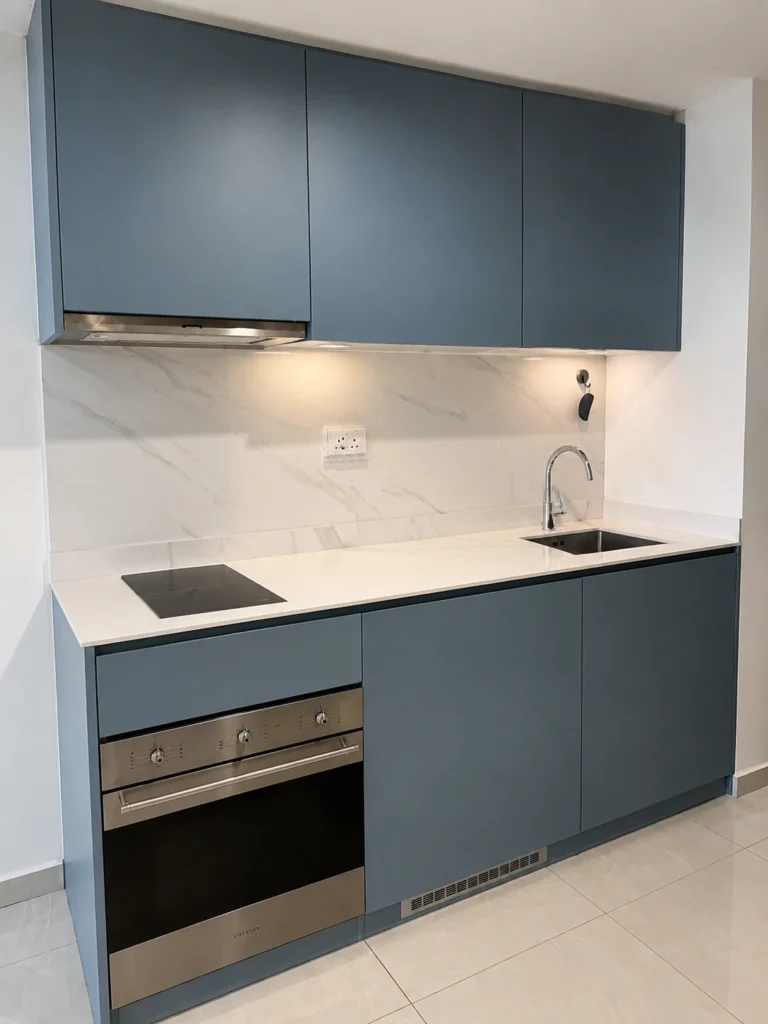
Singapore’s average relative humidity sits between 70% and 90%, with temperatures consistently around 25 to 32°C. This environment is harsh on any organic material, and plywood is no exception.
When properly sealed and maintained, plywood cabinets can last 15 to 20 years (Saha Interiors, 2025). However, that “properly sealed” qualification is doing a lot of work. In Singapore kitchens, where steam from cooking and splashing near the sink are daily realities, sealants degrade faster than they would in a drier climate. Delamination, warping, and swelling are real risks, particularly for lower-grade plywood.
Aluminium modular kitchens, on the other hand, offer exceptional durability with a lifespan of 20 or more years (Saha Interiors, April 2025). Because aluminium does not absorb water, swell, or rot, it holds its structural integrity even in the most demanding kitchen environments. It is also completely termite-proof, a consideration that matters more than many Singapore homeowners initially assume, particularly in older HDB blocks or landed properties.
For homeowners in newer estates who want to future-proof their renovations, exploring options with specialists who cover kitchen cabinets sengkang or kitchen cabinets punggol will give you a better sense of what long-term durability looks like in practice across different property types.
Aluminium composite cabinet frames are also emerging as a hybrid solution, combining metal rigidity with engineered wood panels, and this segment is growing at an 8.1% compound annual growth rate (Data Intelo, 2026). This growth signals that the industry itself is gravitating towards aluminium-dominant solutions.
Maintenance Requirements: Which Is Easier to Keep Clean?
Maintenance is where the gap between these two materials becomes most obvious in day-to-day life.
Aluminium cabinets require very little upkeep. A wipe-down with a damp cloth removes grease, stains, and cooking residue. The powder-coated or anodised surface does not absorb odours or bacteria, and because there are no organic materials involved, there is no risk of mould growth inside the cabinet structure itself.
Plywood cabinets require more active care. The surface finish, whether laminate, paint, or veneer, needs to be kept dry and regularly inspected for peeling or chipping. Edges are particularly vulnerable, as any moisture that penetrates the veneer or laminate can cause delamination. If you have already experienced issues in your current home, understanding how to address water damaged kitchen cabinets is an important first step before choosing your next material.
For busy households cooking multiple meals daily, aluminium’s low-maintenance profile is a genuine quality-of-life advantage, not just a specification on paper.
Design Flexibility and Aesthetics: Where Plywood Still Leads
Aesthetics are a deeply personal decision, and this is one area where plywood still holds a meaningful edge.
Plywood cabinets can be finished in virtually any colour, texture, or material. From high-gloss lacquer to raw wood veneer, the surface possibilities are far broader than what aluminium typically offers. For homeowners designing around a Japandi, Scandinavian, or heritage Peranakan aesthetic, the warmth and tactility of a wood-finished cabinet is hard to replicate in aluminium.
That said, modern aluminium cabinet technology has closed this gap considerably. Powder coating now offers hundreds of colour options, and textured finishes can mimic the appearance of wood grain convincingly. If you are curious about how colour choices affect the overall perception of your kitchen space, understanding what cabinet colours makes a kitchen look bigger is a useful starting point for your planning.
At T Se7en Alucraft, the design team works with clients to develop aluminium cabinet configurations that meet both functional and aesthetic requirements, proving that you do not have to sacrifice visual appeal for durability.
Environmental and Health Considerations

For environmentally conscious homeowners, this comparison has an added dimension worth thinking through carefully.
Plywood contains adhesive resins that may emit formaldehyde, a volatile organic compound (VOC) linked to indoor air quality issues. The level of emission depends on the grade of plywood used. In Singapore, the Singapore Green Building Council encourages the use of low-VOC materials in residential projects, and some lower-quality plywood imports may not meet these standards without specific certification.
Aluminium cabinets, particularly those constructed without timber-based backing boards, emit zero formaldehyde. Aluminium is also one of the most recyclable materials on earth, with a high percentage of the global aluminium stock already existing in recycled form. This makes it a more circular material choice over its full lifecycle.
Metal cabinets represent 14.8% of the global kitchen cabinets market at USD 17.5 billion in 2025, expanding at a 5.6% compound annual growth rate (Data Intelo, 2025). The sustained growth of this segment reflects not just durability concerns but also increasing awareness of health and environmental factors among renovation clients worldwide.
According to Astar Furnishing, aluminium cabinets are increasingly recommended in Singapore specifically because of their suitability for high-humidity tropical environments and their contribution to healthier indoor air quality.
What Industry and Market Trends Tell Us About 2026
The plywood market itself remains substantial, valued at USD 52.5 billion globally in 2025 and expected to reach USD 77.6 billion by 2034 at a compound annual growth rate of 4.31% (IMARC Group, 2025). Plywood is not going anywhere, and for many applications including furniture construction and structural use, it remains the industry standard.
However, within the specific category of kitchen cabinetry, the trajectory clearly favours aluminium and composite aluminium solutions. Search interest for “aluminum kitchen cabinets” peaked at its highest recorded level in August 2025, reaching a normalised value of 100 (Accio, September 2025). This signals genuine consumer interest that is translating into real purchasing decisions.
For Singapore homeowners specifically, the combination of climate pressures, increasing property values (which make long-lasting renovations a better return on investment), and growing awareness of indoor air quality is accelerating the shift towards aluminium.
T Se7en Alucraft: Over 30 Years of Cabinet Expertise in Singapore
With more than 30 years of experience in the carpentry industry, T Se7en Alucraft has built a reputation as Singapore’s specialist in custom-made aluminium fixtures. The team’s expertise spans kitchen cabinets, wardrobes, bathroom vanities, living and dining room furniture, and commercial office furniture, all constructed from aluminium to deliver waterproof, termite-resistant, and eco-friendly results.
Every project is approached with a focus on the specific conditions of the Singapore environment. Whether you are renovating an HDB flat, a condominium unit, or a landed property, the T Se7en team works with you to design a cabinet configuration that performs beautifully for decades. Consultations are available via WhatsApp, video call, or virtual showroom tour, making it simple to begin your design journey from wherever you are.
You can reach the T Se7en Alucraft team at +65 9615 9273 or sales@tse7en.com to discuss your project requirements in detail.
The Bottom Line on Aluminium Cabinets vs Plywood
For Singapore homeowners navigating the aluminium cabinets vs plywood decision in 2026, the evidence points consistently in one direction for kitchen applications: aluminium delivers better durability, lower maintenance, and superior performance in humid tropical conditions. Plywood retains a place in the market for its design warmth and lower initial cost, but the long-term numbers and real-world performance data favour aluminium, particularly in kitchens and bathrooms.
If you are ready to explore what a custom aluminium cabinet solution looks like for your home, the team at T Se7en Alucraft is the right starting point. With over 30 years of hands-on experience and a full range of services from kitchen cabinets to office furniture, they can design a solution that fits your space, your budget, and your lifestyle. Book your appointment today by calling +65 9615 9273 or emailing sales@tse7en.com, and take the first step towards cabinets built to last.
Ready to Build Cabinets That Last Singapore's Climate for Decades?
Your kitchen deserves materials that work as hard as you do, and in Singapore’s heat and humidity, that means choosing a cabinet solution built for the long term. T Se7en Alucraft has spent over 30 years helping Singapore homeowners make the right call on materials, finishes, and configurations, so you never have to second-guess your renovation investment.
Book your appointment with a T Se7en Alucraft consultant today — call +65 9615 9273, email sales@tse7en.com, or ask about a WhatsApp or video call design session to get started from the comfort of your home.
Frequently Asked Questions
Aluminium is generally better for Singapore’s humid climate, offering superior moisture resistance, a longer lifespan, and zero formaldehyde emissions.
In terms of raw durability and low maintenance, aluminium cabinets hold a clear advantage, particularly in kitchens. Plywood remains a strong choice if you prioritise design flexibility, a warmer aesthetic, or a lower upfront investment on a short-term basis.
For most Singapore kitchens, aluminium cabinets outperform plywood on durability, hygiene, and long-term cost-effectiveness.
Aluminium does not warp, swell, or absorb moisture, which makes it a more reliable material in high-humidity environments. Plywood, when properly sealed and maintained, is still a viable option, but it requires more ongoing care to achieve a comparable lifespan.
Aluminium cabinets typically last 20 or more years, while well-maintained plywood cabinets last between 15 and 20 years (Saha Interiors, 2025).
The key difference is how each material ages under real Singapore conditions. Aluminium maintains its structural integrity with minimal intervention, whereas plywood requires consistent sealing and surface maintenance to reach its maximum lifespan potential.
Aluminium is the best material for kitchen cabinets in Singapore when durability, moisture resistance, and low maintenance are the primary criteria.
For decorative or low-moisture applications such as display shelves or bedroom wardrobes, high-quality plywood with a protective finish can also perform well. The best material ultimately depends on where the cabinet will be installed and what conditions it will face.
Aluminium cabinets can sound hollow when knocked, may feel colder to the touch, and offer a slightly narrower range of surface finishes compared to plywood.
Installation costs for custom aluminium configurations can also be higher upfront than standard plywood cabinets, depending on the complexity of the design. However, these trade-offs are often outweighed by the long-term savings on maintenance and replacement over the cabinet’s lifespan.
Still Unsure?
Speak to a professional now and get personalized consultation and guidance for your next renovation. Work with a team you can trust!
Best Materials for Kitchen Cabinets in Singapore
Home Blog Aluminium cabinets offer superior moisture resistance and a lifespan exceeding 20 years, making them particularly well-suited to Singapore’s humid tropical climate. Plywood cabinets,...