


Aluminium Kitchen Cabinet Load Capacity: What Every Singapore Homeowner Needs to Know in 2026
Aluminium kitchen cabinets can support substantial loads when correctly specified, installed, and maintained. Understanding aluminium kitchen cabinet load capacity before your renovation begins helps you avoid costly structural failures and keeps your kitchen safe for years to come.
Key Takeaways
- KCMA-certified cabinets are load-tested to 600 pounds (approximately 272 kg) for wall-mounted units, making this the industry benchmark to reference when evaluating any cabinet system.
- Aluminium cabinet load capacity varies significantly depending on alloy grade, profile thickness, shelf span, and the quality of wall anchoring.
- Shelves under KCMA protocols are tested at 15 pounds per square foot (around 73 kg/m²) over seven days, a useful baseline for estimating real-world storage loads.
- Stainless steel delivers roughly three times the load capacity of extruded aluminium assemblies, so for very heavy appliance storage, hybrid or reinforced designs may be worth considering.
- T Se7en Alucraft, with over 30 years of industry experience, engineers its aluminium cabinets to meet Singapore’s humid climate demands without sacrificing structural performance.
- Always request written load ratings from your cabinet supplier before signing off on any installation.
Why Load Capacity Matters More Than Most Homeowners Realise
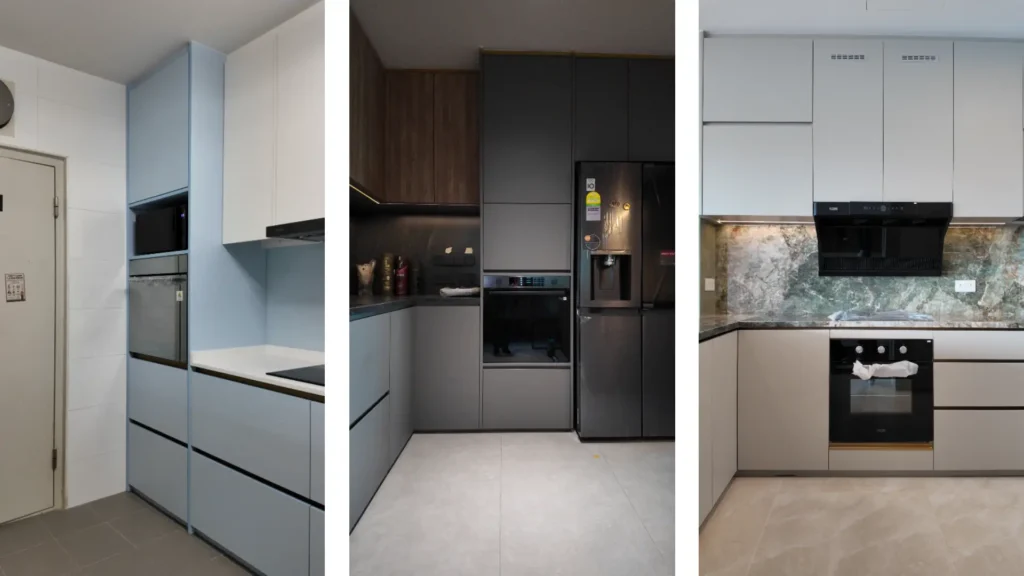
Walk into almost any HDB flat or condominium kitchen in Singapore and you will find cabinets carrying a surprisingly heavy load. Rice cookers, instant pots, heavy ceramic plates, glass storage jars, cast iron pans, and multiple small appliances all add up fast. A single base cabinet shelf loaded with appliances can easily carry 30 to 40 kg or more before you factor in the cabinetry itself.
Yet most homeowners focus on finish colour, door style, and price per linear metre. Load capacity is often the last question asked, and sometimes it is never asked at all. That oversight can lead to sagging shelves, buckled frames, or worse, a wall cabinet pulling free from its anchor points.
The kitchen cabinet industry benchmark comes from the Kitchen Cabinet Manufacturers Association (KCMA). Under KCMA A161.1 certification standards, approved wall cabinets must withstand a 600-pound (approximately 272 kg) load test, and shelves are subjected to sustained loading at 15 pounds per square foot, maintained for seven days, according to KCMA testing protocols (2025). These figures are not aluminium-specific, but they provide a recognised baseline that any reputable supplier should be able to reference.
Understanding aluminium profile vs panel kitchen cabinets is also relevant here, because the structural approach differs substantially between the two systems and directly affects the load each configuration can carry.
How Aluminium Grade and Profile Thickness Affect Structural Performance
Not all aluminium is created equal, and the aluminium grade for kitchen cabinets that your cabinet maker specifies has a direct bearing on how much weight your shelves and frames can support over time. The most commonly used grades in furniture-grade cabinetry are from the 6000-series (6061 and 6063 being the most prevalent), which offer a practical balance of machinability, corrosion resistance, and structural strength.
A thicker aluminium extrusion profile will resist bending under load far better than a thinner one. For base cabinets carrying heavy countertops and appliances, profiles of 1.5 mm to 2 mm wall thickness are a reasonable minimum. For wall cabinets, the extrusion thickness is less critical than the anchor system, but frames still need adequate rigidity to distribute load evenly across the hanging brackets.
If you are specifying cabinets for a particularly demanding application, understanding the details will help you ask the right questions and compare supplier specifications meaningfully.
It is also worth noting that a published comparison from Fadior Home Journal (2026) indicates that stainless steel construction delivers approximately three times the load capacity of extruded aluminium assemblies. This does not make aluminium a poor choice. For the vast majority of Singapore residential kitchens, the loads involved fall well within aluminium’s comfortable operating range. However, for commercial kitchens or specialist storage applications involving very heavy equipment, this trade-off is worth factoring into the material selection conversation.
Base Cabinets vs Wall Cabinets: Different Load Demands, Different Engineering
The structural requirements for base and wall cabinets are fundamentally different, and conflating the two is a common mistake.
Base cabinets sit on the floor, and their load path goes directly downward through the carcass to the base frame and into the floor. This makes them inherently more stable under heavy loads. The countertop weight, appliance weight, and stored item weight all transfer vertically. The critical failure points in base cabinets are typically the shelf supports and drawer mechanisms rather than the frame itself.
Wall cabinets are a different matter entirely. Every kilogram stored inside a wall cabinet is transmitted through the cabinet carcass to the wall anchors, which then transfer the load to the wall structure. In Singapore, wall construction varies considerably across property types. Older HDB flats often have brick or concrete walls that accept anchors well. Some condominium units feature drywall or lightweight partition systems that require specialist fixings and careful load calculations.
For wall cabinets, the anchoring system is often the limiting factor, not the aluminium frame. Proper installation using appropriate rawl plugs or chemical anchors into masonry, combined with a correctly specified hanging rail, is what separates a safe installation from a potential hazard.
When you are planning a aluminium cabinet for built in oven installation alongside your wall cabinetry, the load and heat considerations compound. Reviewing the requirements will help you understand how the structural and thermal demands interact.
Drawer Load Ratings: Often Overlooked, Frequently Overloaded
Drawers tend to receive less attention than shelves when homeowners think about weight limits, yet they are frequently overloaded with cutlery, baking tools, kitchen linens, and miscellaneous hardware that accumulates over years.
The load-bearing capacity of a kitchen drawer depends on three components working together: the drawer box itself, the slide mechanism (also called a runner or glide), and the connection between the drawer box and the carcass.
For aluminium drawer boxes, the alloy construction gives them excellent rigidity and resistance to warping from moisture. The limiting factor in most cases is the drawer slide rating, which is specified by the hardware manufacturer. Quality undermount slides rated for 40 kg to 50 kg are readily available and appropriate for most Singapore kitchens. For pull-out pantry units or pot drawers carrying very heavy loads, slides rated at 70 kg or above are advisable.
Soft-close mechanisms add some engineering complexity but do not meaningfully reduce load capacity when correctly specified. If you are uncertain about the load rating of the slides in your proposed design, request the manufacturer’s specification sheet and verify it matches your anticipated use.
What You Can Store on Top of Cabinets (and What You Should Not)
In Singapore’s compact kitchens, the space above wall cabinets is tempting storage territory. Large serving platters, seldom-used appliances, and decorative items frequently end up piled on top of cabinet carcasses.
The top panel of a wall cabinet is not engineered as a load-bearing surface. It is typically the thinnest panel in the assembly, designed to close off the top of the carcass aesthetically rather than to support weight from above. Loading this surface with heavy items risks deforming the panel and, in extreme cases, distorting the frame below.
A practical rule is to limit items placed on top of wall cabinets to genuinely lightweight objects, such as wicker baskets, lightweight trays, or decorative plants in small pots. For anything heavier, a purpose-built shelf or a separate storage solution is a safer choice.
The long-term durability of your cabinetry also depends on how well it resists the environmental conditions common in Singapore homes, and understanding whether can aluminium kitchen cabinets rust under Singapore’s humidity levels will clarify what surface treatment and alloy combinations are most appropriate.
Material Longevity and Pest Resistance: Why These Affect Structural Integrity Over Time
A cabinet system’s practical load capacity is not just about what it can hold on day one. It is about whether the structure maintains that capacity over years of use in a humid tropical environment.
Timber and MDF cabinets are vulnerable to moisture absorption, which causes swelling, warping, and eventual structural weakening. A shelf that comfortably holds 20 kg when new may sag noticeably after three or four years of exposure to Singapore’s humidity levels. This degradation reduces the effective load capacity of the system over time.
Aluminium does not absorb moisture and does not swell, warp, or rot. This means the structural integrity of a well-made aluminium cabinet remains consistent across its service life. For Singapore homeowners, this is a meaningful practical advantage that compares favourably against timber alternatives over a ten-to-fifteen-year horizon.
Pest resistance is similarly relevant, and learning whether are aluminium kitchen cabinets termite proof will confirm what many homeowners already suspect: aluminium simply does not present a food source for termites, making it inherently resistant to this particular risk.
The quality of fabrication also plays a major role in long-term structural performance, and reviewing aluminium kitchen cabinet workmanship standards will help you distinguish between suppliers who invest in engineering quality and those who prioritise only visual finish. Poor joinery, undersized fasteners, and inadequate panel support systems will all compromise load capacity regardless of the material used.
T Se7en Alucraft's Approach to Structural Engineering in Singapore Kitchens
T Se7en Alucraft has been working in Singapore’s carpentry and custom aluminium fixture industry for over 30 years, and that experience directly informs how the team approaches load capacity in kitchen cabinet design.
Every project begins with a detailed consultation that accounts for the specific storage loads the homeowner anticipates. The alloy grade, profile thickness, shelf span, support system, and anchoring method are all selected to suit the actual use case rather than defaulted to a generic standard specification.
For wall cabinets, T Se7en specifies hanging rail systems that distribute load across multiple anchor points, reducing the stress on any single fixing. For base cabinets, adjustable shelf supports rated for appropriate loads are paired with properly braced carcass frames to ensure consistent performance over time.
The global kitchen cabinet market reached S$177.68 billion in 2025 and is projected to grow to S$253.96 billion by 2030 at a 7.5% compound annual growth rate, according to The Business Research Company (2025). Within this expanding market, the demand for genuinely durable, performance-specified cabinetry is growing, and aluminium kitchen cabinet load capacity is increasingly a purchasing criterion rather than an afterthought.
Homeowners in Singapore can reach T Se7en Alucraft directly at +65 9615 9273 or via sales@tse7en.com to discuss specific load requirements, obtain a detailed design consultation, or arrange a WhatsApp or video call session to review options for their renovation project.
A Practical Load Capacity Reference Table
| Cabinet Type | Typical Load Capacity | Key Limiting Factor |
|---|---|---|
| Base cabinet (aluminium frame) | 50 to 100 kg per shelf | Shelf span and support pin rating |
| Wall cabinet (aluminium frame) | Subject to KCMA 272 kg test benchmark | Wall anchor system and wall construction |
| Drawer (standard slide, 40 kg rating) | Up to 40 kg per drawer | Drawer slide specification |
| Drawer (heavy-duty slide, 70 kg rating) | Up to 70 kg per drawer | Drawer box rigidity |
| Top of wall cabinet (non-structural panel) | Lightweight items only (under 5 kg) | Panel thickness, not engineered for load |
| Pull-out pantry unit | Up to 70 kg total | Combined slide rating and frame rigidity |
Note: Figures represent general guidance for aluminium cabinet systems. Always confirm specific ratings with your supplier’s engineering documentation.
Ready to Plan a Kitchen That's Built to Last?
Singapore kitchens work hard every day, and your cabinets need to keep up. If you have been wondering whether your planned layout can handle the loads you have in mind, T Se7en Alucraft’s consultants can walk you through the engineering decisions that matter, from alloy grade and profile thickness to anchoring systems and drawer slide ratings.
With over 30 years of experience designing custom aluminium fixtures for Singapore homes, T Se7en Alucraft brings technical depth to every kitchen project, not just aesthetic choices. Book your appointment today and get a personalised consultation that covers your actual storage needs, wall construction type, and budget in one focused session.
Contact T Se7en Alucraft on WhatsApp or by phone at +65 9615 9273 to arrange your consultation, whether in person, via video call, or through a virtual showroom tour.
The Bottom Line on Aluminium Kitchen Cabinet Load Capacity
Getting aluminium kitchen cabinet load capacity right is not complicated, but it does require asking specific questions before you commit to a design. Knowing the KCMA benchmark, understanding how alloy grade and profile thickness affect performance, specifying drawer slides to match your actual storage habits, and confirming your wall anchor system suits your wall construction type are the four decisions that matter most.
T Se7en Alucraft has spent over 30 years helping Singapore homeowners navigate exactly these choices, combining technical precision with design expertise to deliver kitchen cabinets that perform as well as they look. Reach out at sales@tse7en.com or call +65 9615 9273 to start a conversation about your project, and let the team help you build a kitchen that carries its load comfortably for decades to come.
Frequently Asked Questions
Wall cabinets tested under KCMA A161.1 certification must withstand a 600-pound (approximately 272 kg) load, while shelves are rated at 15 pounds per square foot sustained over seven days.
This benchmark applies to certified cabinets regardless of material, and it represents the industry standard most reputable suppliers reference. In practice, individual shelf capacity in residential kitchens typically falls in the 20 to 50 kg range per shelf, depending on shelf span, support system, and the cabinet’s overall construction quality. Always request your supplier’s written load specification before finalising your design.
Aluminium is an excellent material for kitchen cabinets in Singapore’s climate, offering moisture resistance, structural consistency, and long service life without the warping or pest vulnerability common in timber alternatives.
Unlike MDF or timber, aluminium does not absorb humidity, swell, or rot, which means its structural integrity remains stable across years of use in Singapore’s tropical environment. It is also inherently resistant to termites, which cause significant concealed damage to timber cabinets in the region. The trade-off is that extruded aluminium assemblies carry a lower peak load capacity than stainless steel, though for standard residential kitchen use, aluminium performs comfortably within the required range.
A standard kitchen drawer fitted with quality 40 kg-rated undermount slides can safely carry up to 40 kg, while heavy-duty slides rated at 70 kg or above are available for pot drawers and pull-out pantry applications.
The drawer slide, or runner, is usually the limiting component rather than the drawer box itself, particularly in aluminium drawer systems where the box is inherently rigid and moisture-resistant. For everyday use involving cutlery, utensils, and light cookware, a 40 kg rating is more than adequate. If you plan to store cast iron cookware, heavy baking equipment, or large volumes of tinned goods in a pull-out unit, specifying 70 kg slides from the outset is a straightforward and cost-effective precaution.
The top panel of a wall cabinet is not a structural surface and should only carry lightweight items, generally under 5 kg, such as decorative baskets or small plants.
The top panel closes off the carcass aesthetically and is typically the thinnest panel in the assembly. It is not engineered to bear downward load from stored items above. Placing heavy appliances, large serving dishes, or stacked boxes on top of wall cabinets risks deforming the panel and distorting the frame below over time. If you need accessible storage above your wall cabinets, a purpose-built overhead shelf anchored directly to the wall structure is a far safer and more practical solution.
The self-weight of an aluminium kitchen cabinet carcass varies depending on size and profile specification, but a typical wall cabinet unit generally weighs between 8 kg and 20 kg, while base cabinets can range from 15 kg to 35 kg before any doors, drawers, or hardware are fitted.
Aluminium is notably lighter than timber or MDF for equivalent structural performance, which is one reason it places less stress on wall anchor systems during installation. This lower self-weight also makes transport and on-site handling easier during renovation works. When calculating the total load your wall anchors need to carry, remember to add the cabinet’s self-weight to the weight of stored contents to get an accurate picture of the real demand on your fixings.
Still Unsure?
Speak to a professional now and get personalized consultation and guidance for your next renovation. Work with a team you can trust!
Best Materials for Kitchen Cabinets in Singapore
Home Blog An aluminium kitchen cabinet carcass is the structural skeleton of your kitchen cabinet, built entirely from aluminium rather than wood, plywood, or MDF....