



Kitchen cabinet doors sagging is one of the most common maintenance issues faced by homeowners in Singapore, typically caused by loose hinges, warped frames, or moisture damage. The good news is that most cases can be resolved with the right adjustments, the correct hardware, and a clear understanding of what is actually causing the problem.
Key Takeaways
- Seven in ten HDB flat buyers opt for open kitchen designs, making islands increasingly practical rather than purely aesthetic (HDB Key Statistics 2024/2025).
- Minimum clearance of 90 cm to 100 cm around all sides of an island is essential for comfortable movement in HDB kitchens.
- Aluminium-framed islands offer a significant advantage in Singapore’s humid climate over solid wood alternatives.
- A built-in island with storage underneath doubles usable space, critical in 3-room and 4-room HDB layouts.
- Cost varies widely depending on material and size; planning your budget early prevents mid-project surprises.
- Coordinating your island design with your cabinet finish creates a cohesive, polished result without a major redesign.
Why Kitchen Cabinets Drop and Drift Over Time
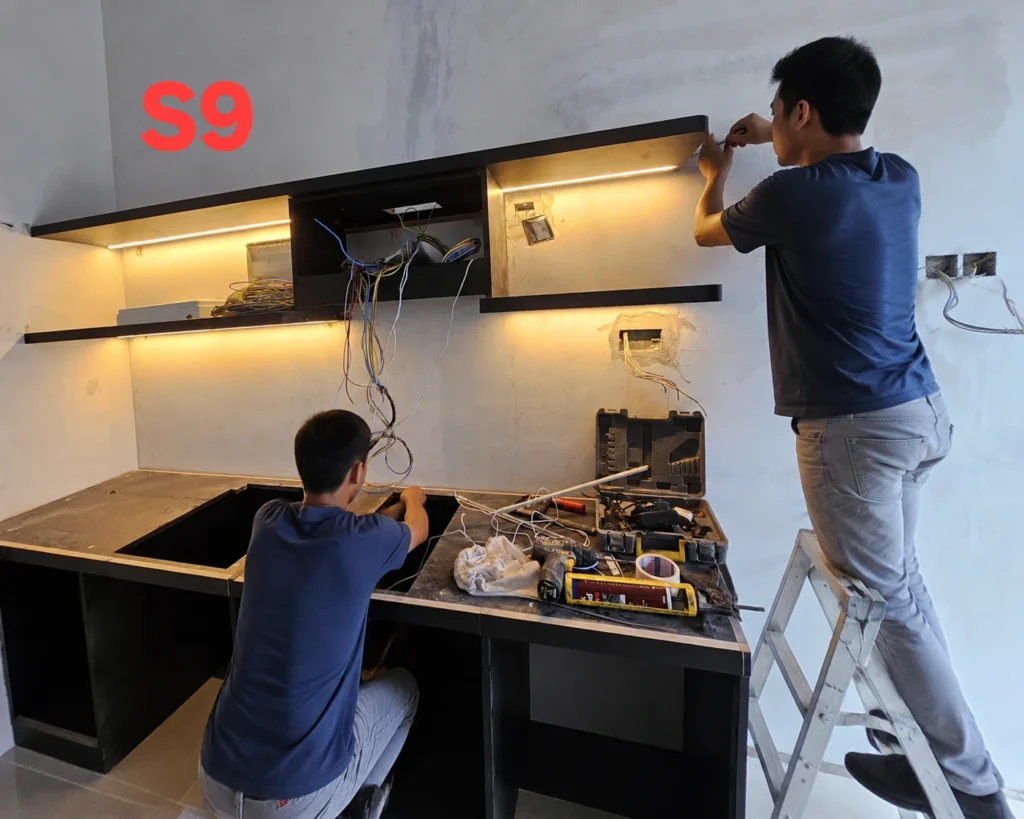
Before reaching for your screwdriver, it helps to understand what is actually going on. Kitchen cabinet doors rarely sag for just one reason. In most cases, it is a combination of gradual factors that build up over months or even years.
The most common causes include:
- Loose or stripped hinge screws: Over time, repeated opening and closing causes screws to work their way out of the cabinet frame. Once the screw hole is stripped, the hinge has nothing solid to grip.
- Worn or low-quality hinges: Cheap concealed hinges lose their spring tension after sustained use. A hinge that no longer holds its position will allow the door to droop.
- Wood swelling and shrinkage: In Singapore’s tropical climate, timber and MDF cabinet doors absorb and release moisture throughout the year. This causes the wood to expand and contract, gradually distorting the shape of the door and stressing the hinges.
- Overloading: Heavy cabinet doors, particularly those made from solid timber or with glass panels, put more strain on hinges than standard doors. If the hinges are not rated for that load, sagging is inevitable.
- Frame movement: If the cabinet carcass itself has shifted, whether from settlement, poor installation, or water damage at the base, the door alignment will change even if the hinges are perfectly intact.
Understanding which of these applies to your situation determines whether you need a simple adjustment or something more substantial. Homeowners planning a renovation should also check out common kitchen renovation mistakes singapore to avoid creating the conditions for these problems in the first place.
How Singapore's Climate Speeds Up the Problem
Humidity is a genuine challenge for cabinet maintenance in Singapore. Average relative humidity sits consistently above 80%, and many kitchens experience even higher moisture levels from cooking, steam, and poor ventilation. For timber or MDF-based cabinet doors, this environment is genuinely punishing.
Moisture causes wood fibres to swell and the door to become heavier and slightly warped. Even a small warp of a few millimetres at the corner is enough to throw off the hinge alignment and create a visible gap at the top or bottom of the door. Over time, repeated wetting and drying cycles cause the screw holes to loosen as the timber around them deteriorates.
This is why aluminium cabinetry has become an increasingly popular choice for Singapore homes. Aluminium does not absorb moisture, does not warp, and does not rot. At T Se7en Alucraft, our aluminium kitchen cabinets are specifically engineered for Singapore’s climate, giving homeowners a long-term solution rather than a recurring maintenance problem.
If you are considering a new kitchen layout, exploring options like an hdb kitchen island as part of your renovation may also be an opportunity to reassess your cabinet materials before the same moisture issues reappear.
Diagnosing the Exact Source of the Sagging
A common mistake homeowners make is adjusting the hinge before checking whether the hinge is actually the problem. Taking ten minutes to diagnose properly will save you time and frustration.
Step 1: Check the hinge screws first. Open the door and press firmly on the hinge plates. If they feel loose or move when pressed, stripped screws are likely your primary issue.
Step 2: Inspect the door itself. Lay the door flat on a surface (if it can be removed safely) and check whether it rocks or shows any visible curve across its face. Even a slight bow will affect how it sits in the frame.
Step 3: Check the cabinet carcass. Use a spirit level along the top and sides of the cabinet box. If the carcass has shifted, the doors will always drift out of alignment regardless of how many times you adjust the hinges.
Step 4: Examine the hinge mechanism. Most modern kitchens in Singapore use European-style concealed hinges with adjustment screws. Check whether the adjustment screws have drifted from their original position, and whether the hinge spring is still providing resistance.
This diagnostic process is especially important if you have recently renovated and are still within a short timeframe post-completion. Understanding how long does kitchen renovation take in singapore also gives context on the settling period your new cabinets go through, during which minor adjustments are perfectly normal.
Practical Fixes Ranked From Simplest to Most Involved

Once you have identified the cause, here is a practical hierarchy of fixes, starting from the simplest.
Tightening or Replacing Hinge Screws
If the screws are simply loose, tighten them fully. If the screw holes are stripped and the screws spin freely, you have a few options:
- Fill the hole with wooden toothpicks and wood glue, allow to dry, then re-drive the original screw.
- Use a longer screw that reaches deeper into solid timber.
- Insert a screw anchor into the hole before re-driving the screw.
These are low-cost, effective fixes that take less than 30 minutes per door.
Adjusting Concealed Hinges
European-style concealed hinges have three adjustment axes: vertical (up/down), horizontal (side to side), and depth. The adjustment screws are usually accessible with a Phillips screwdriver without removing the door.
| Adjustment Type | Screw Position | Effect |
|---|---|---|
| Vertical | Slot on mounting plate | Moves door up or down |
| Horizontal | Side screw on hinge arm | Moves door left or right |
| Depth | Front screw on hinge arm | Moves door closer or further from frame |
Start with the vertical adjustment if the door is noticeably lower on one side. Make quarter-turn adjustments and check alignment after each turn.
Replacing the Hinges Entirely
If the hinge mechanism itself has failed, replacement is the right call. When sourcing replacement hinges, pay close attention to the quality of the hardware, and is higold accessories really worth the money gives a detailed breakdown of one of the leading hardware brands available in Singapore regarding whether there is a meaningful difference between budget hinges and premium options.
Addressing the Cabinet Frame
If the frame itself has shifted or is structurally compromised, adjusting doors will only mask the real problem. In this case, you may need to re-level the cabinet carcass using adjustable legs or shims, or assess whether the unit needs to be replaced altogether, and kitchen cabinet repair vs replacement lays out the key considerations clearly.
The Case for Aluminium: A Long-Term Solution
For homeowners who have dealt with kitchen cabinet doors sagging multiple times on the same set of cabinets, the honest answer may be that the cabinets themselves are the problem rather than the hinges.
Timber and MDF cabinets, while popular for their appearance and lower upfront cost, have inherent vulnerabilities in Singapore’s climate. Repeated sagging is often a symptom of a cabinet material that is gradually failing.
Aluminium cabinetry addresses this at the root. At T Se7en Alucraft, with over 30 years of experience in carpentry and aluminium fabrication, we build kitchen cabinets that are:
- Waterproof and humidity-resistant, with no risk of swelling or warping
- Lightweight but structurally rigid, reducing hinge stress
- Compatible with high-quality concealed hinge systems rated for long-term use
- Easy to clean and maintain in Singapore’s kitchen environment
For homeowners in smaller flats, our experience with 3 room hdb kitchen renovation projects shows that even compact kitchens benefit significantly from aluminium over timber when longevity and low maintenance are priorities.
When to Call a Professional
Some situations genuinely call for professional intervention rather than a DIY approach:
- The cabinet frame has sustained water damage at the base or side panels
- Multiple doors across the kitchen are sagging simultaneously, suggesting a systemic installation problem
- The wall fixing points for wall-mounted cabinets have failed or show signs of cracking
- You are unsure whether the structure above or behind the cabinet is sound
In Singapore, wall-mounted kitchen cabinets are governed by HDB guidelines for anchoring and fixing loads. If you have any concern about structural safety, it is always better to have a professional assess the situation before attempting a repair.
Prevention: How to Avoid the Problem Recurring
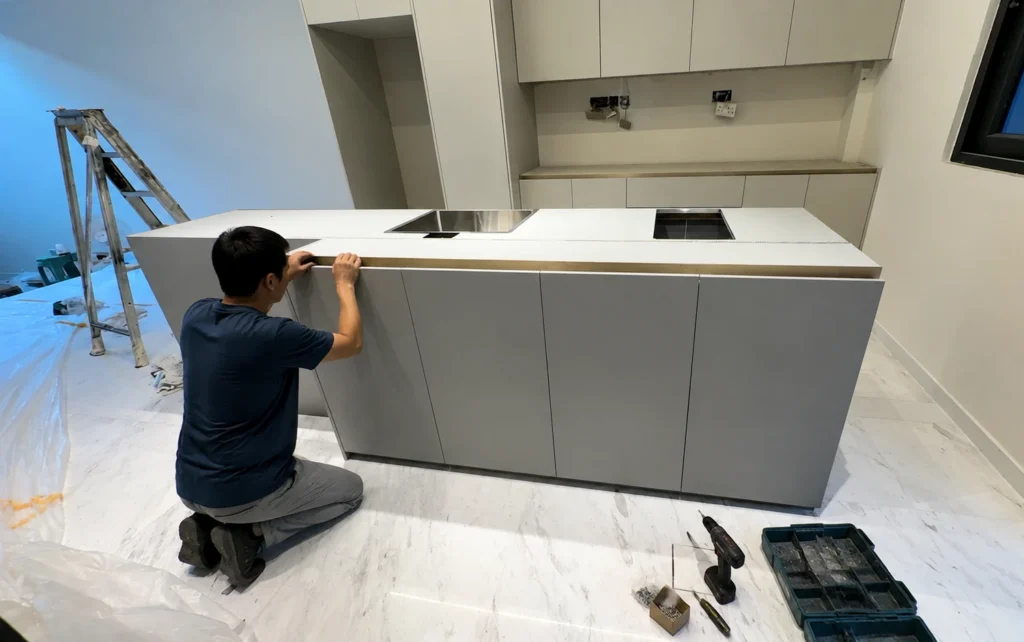
Once you have resolved your current sagging issue, a few simple habits will keep your cabinet doors in alignment for the long term.
Regular maintenance checks:
- Every six months, check all hinge screws for tightness.
- Wipe down hinge mechanisms with a dry cloth to remove grease build-up.
- Apply a small amount of silicone lubricant to hinge pivot points annually.
Choosing the right hardware from the start:
- Invest in hinges rated for the weight of your specific door type.
- For heavy doors (glass panels, thick timber), use heavy-duty hinges with a higher load rating.
- Use stainless steel or zinc-alloy screws, not plain steel, to resist corrosion in Singapore’s humid environment.
Material selection:
- If you are renovating or replacing cabinets, consider aluminium or moisture-resistant materials that are better suited to Singapore’s climate.
- Avoid low-density MDF for cabinet doors in kitchens with poor ventilation.
Consistent attention to these points means that kitchen cabinet doors sagging becomes a one-time problem rather than a recurring inconvenience.
Things to Know
- Most concealed hinges used in Singapore kitchens have three adjustment axes built in, meaning you can often fix minor sagging without buying any new parts at all.
- Stripped screw holes are the single most overlooked cause of recurring door drop. If you keep tightening the same screw and it keeps loosening, the hole is the problem, not the screw.
- Singapore’s HDB kitchens tend to have thinner cabinet carcass walls than landed property cabinetry, which means screw depth matters more and toothpick-and-glue repairs work just as well as expensive anchors.
- Wall-mounted cabinets that sag at the frame level, rather than at the door level, may indicate a wall anchor failure. This is a structural issue and should be assessed by a professional before any DIY adjustment is attempted.
- The weight of the cabinet door directly determines how quickly hinges wear out. Glass-panel doors and thick solid timber doors require hinges with a higher load rating than standard concealed hinges provide.
- Aluminium cabinet frames do not absorb moisture, which means the screw holes and hinge mounting points remain stable over time, a significant advantage over timber and MDF in Singapore’s climate.
Stop Living With Drooping Doors, Book a Free Cabinet Consultation
If your cabinet doors have been sagging for months and basic adjustments have not held, the underlying issue may be the cabinet material itself. At T Se7en Alucraft, we specialise in custom aluminium kitchen cabinets built specifically for Singapore’s humidity, designed to stay aligned, stay strong, and look great for decades without the maintenance headaches.
Book your appointment with our consultants today and find out exactly what is causing your sagging doors and what the most cost-effective solution looks like for your home. Call us at +65 9615 9273, email sales@tse7en.com, or reach out via WhatsApp to arrange a video call design session or virtual showroom tour at a time that suits you.
The Bottom Line on Kitchen Cabinet Doors Sagging
Kitchen cabinet doors sagging is rarely a sign of a catastrophic problem, but it is a signal worth taking seriously. Left unaddressed, a door that droops by a few millimetres today can lead to damaged frames, broken hinges, and scratched cabinet faces over time. The fixes range from a five-minute screw tightening to a full cabinet replacement, and knowing which one applies to your situation is what makes the difference between a lasting repair and a recurring frustration.
If you are finding that the same doors keep dropping no matter how many times you adjust them, it may be time to look at the materials your cabinets are made from. T Se7en Alucraft has spent over 30 years helping Singapore homeowners move away from maintenance-heavy timber and MDF cabinetry towards aluminium solutions that simply do not have these problems. Reach out to our team at +65 9615 9273 or visit www.tse7en.com to start a conversation about what your kitchen actually needs.
Frequently Asked Questions
Start by identifying whether the sag is coming from the door, the hinges, or the cabinet frame itself, as each requires a different approach.
If the hinge screws are loose, tighten them or fill stripped holes with toothpicks and wood glue before re-driving the screws. If the concealed hinge has drifted out of position, use the vertical and horizontal adjustment screws to realign the door. If the cabinet carcass has shifted, re-levelling with shims or adjustable legs is necessary before any door adjustment will hold long-term.
A door that sags repeatedly after adjustment almost always has either stripped screw holes, a worn hinge mechanism, or a warped door that is placing uneven stress on the hinge.
Replace the hinge entirely if the spring tension has failed, as no amount of adjustment will compensate for a hinge that can no longer hold its position. For stripped holes, use a longer screw or insert a wall anchor to give the fixing point fresh material to grip. If the door itself is warped, particularly common with timber and MDF in Singapore’s humid conditions, replacement of the door panel may be the most practical solution.
For most sagging cabinet doors, the fix involves a combination of tightening loose screws, adjusting the concealed hinge using its built-in adjustment screws, and addressing any warping in the door panel itself.
Begin with the simplest intervention first: check and tighten all hinge screws before touching the hinge adjustment. Then use a Phillips screwdriver on the vertical adjustment screw to raise the low side of the door until both edges sit level with the cabinet frame. If the problem returns within a few weeks, the hinge itself or the screw holes need attention rather than further adjustment.
A sagging cabinet base is typically caused by moisture damage to the base panel, overloading of the shelf, or failure of the adjustable legs or plinth system beneath the carcass.
Remove the contents of the cabinet and inspect the base panel for softness, discolouration, or visible swelling, all signs of water ingress. If the base panel is structurally compromised, it will need to be cut out and replaced with a moisture-resistant board or, ideally, an aluminium panel. If the adjustable legs beneath the carcass have shifted, re-levelling them with a spirit level and tightening the locking collars will restore the base position and relieve stress on the door alignment above.
Repeatedly loose hinges almost always point to stripped screw holes rather than faulty hinges, and the fix is to restore the integrity of the fixing point rather than simply re-tightening the same screws.
The most reliable DIY method is to remove the hinge, fill the screw holes completely with wooden toothpicks and PVA or wood glue, allow the glue to cure fully for at least 24 hours, then trim the toothpicks flush and re-drive the original screws into the solid new material. For a more permanent solution, particularly in high-use cabinets or on heavier doors, use a screw anchor insert rated for the load. If hinges continue to come loose after this repair, the cabinet carcass wall itself may be too thin or damaged to hold fixings reliably, and a professional assessment from a contractor like T Se7en Alucraft is recommended.
Still Unsure?
Speak to a professional now and get personalized consultation and guidance for your next renovation. Work with a team you can trust!
Best Materials for Kitchen Cabinets in Singapore
Home Blog HIP is HDB’s upgrading programme for older flats. It covers compulsory repairs such as concrete defects and ageing waste pipes at a very...
2 responses