

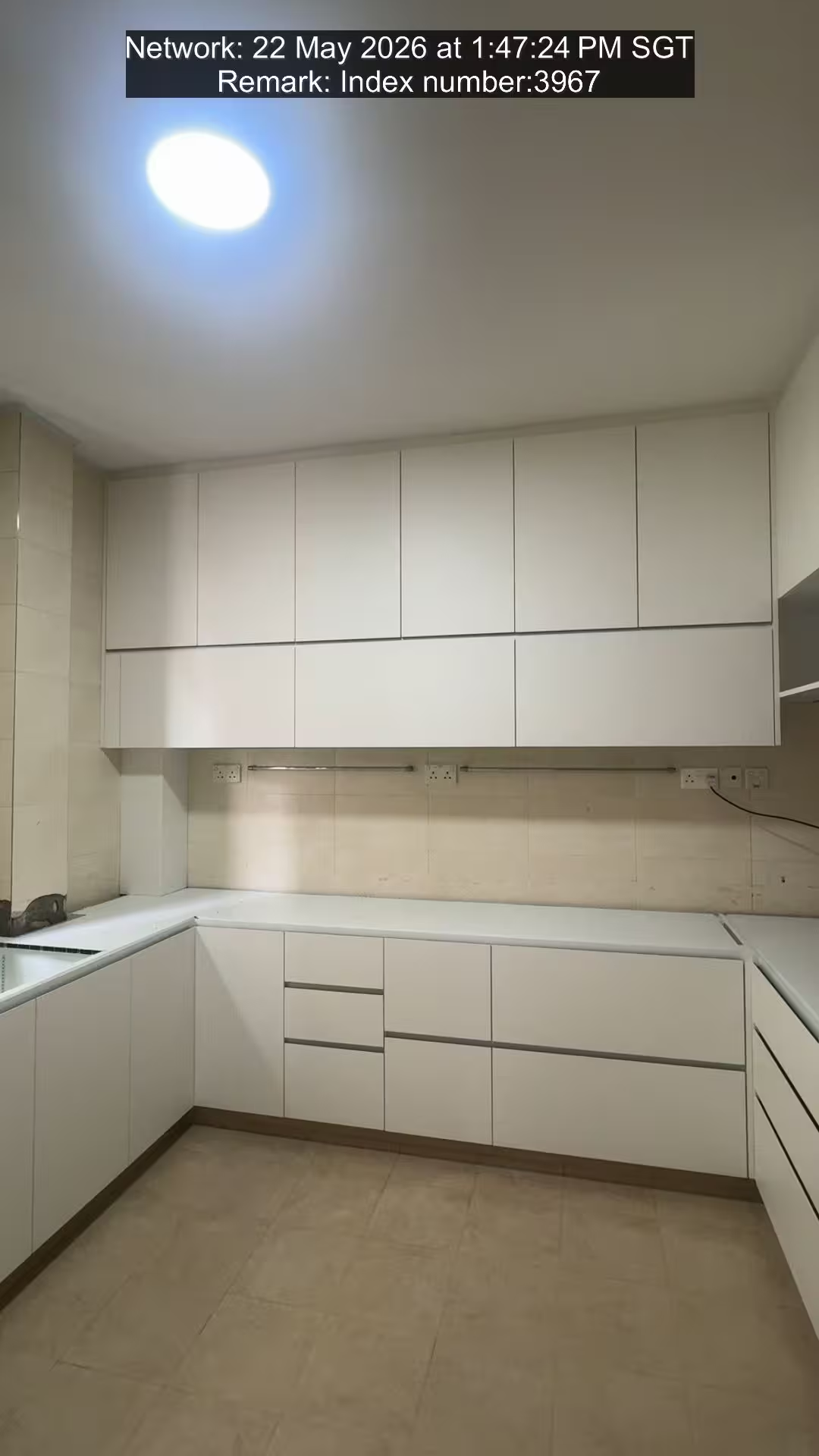

What Cabinet Colour Makes a Kitchen Look Bigger (and Which Colours to Avoid)
White, soft neutral, and pale-toned cabinets are consistently the most effective choices when you want a kitchen cabinet colours to feel more spacious. The physics behind this is straightforward: lighter surfaces reflect more natural and artificial light back into the room, which visually expands the perceived boundaries of the space.
Key Takeaways
- White and off-white cabinet colours remain the single strongest tool for making a small kitchen feel larger, according to design consensus reported by Homes and Gardens (2022).
- Light reflectance matters more than paint shade alone; the finish (gloss vs. matte) significantly affects how much light bounces around the room.
- Pairing light cabinets with matching or near-matching walls and ceilings amplifies the effect by removing visual interruptions.
- Very dark, heavily saturated, or warm-heavy colours tend to absorb light and compress the perceived size of a space.
- Cabinet colour is one piece of a larger picture; handle style, door profile, and cabinet condition all contribute to how open or closed a kitchen feels.
- Upgrading ageing or damaged cabinetry before repainting or refinishing gives you the best possible result from any colour choice.
Why Colour Affects How Big Your Kitchen Feels
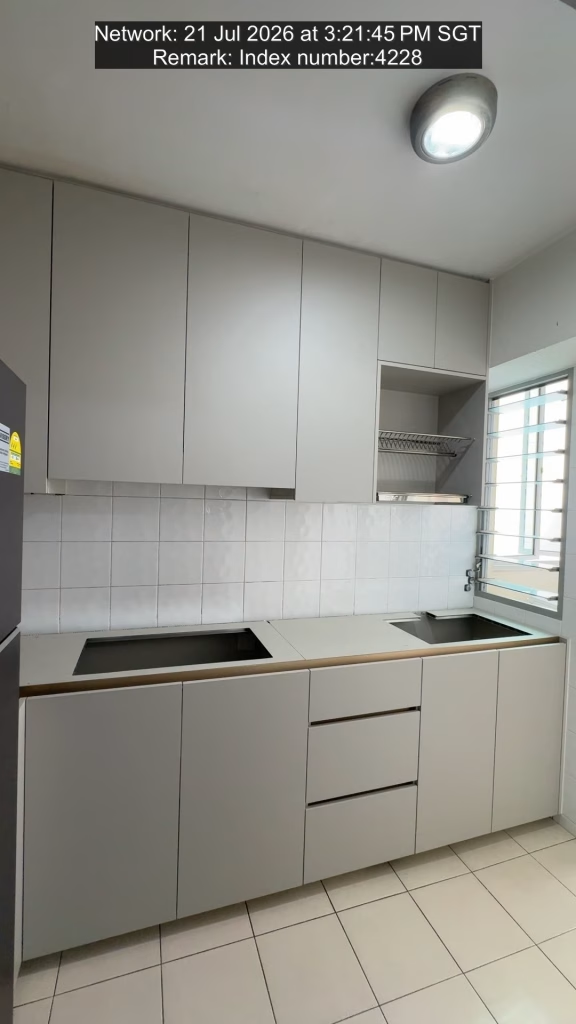
Before committing to any shade, it helps to understand the mechanism at work. Human perception of room size is heavily influenced by contrast, light intensity, and how surfaces handle reflection. Dark or richly saturated colours absorb light, which causes walls, ceilings, and cabinet faces to visually merge into a heavy, enclosed-feeling mass. Light or cool-toned colours do the opposite: they bounce light around, creating visual separation between surfaces and making a room feel less compressed.
Mars Brothers Kitchen and Bath (July 2026) references research published by the National Institute of Standards and Technology (NIST) on reflectance values of surfaces, noting that how much light a material bounces back is one of the core physical drivers behind perceived spatial size. In practical terms, a high-reflectance cabinet finish in a pale tone does measurable optical work that a deep navy or forest green simply cannot replicate.
This principle applies regardless of whether your kitchen is in a kitchen cabinets tampines five-room flat or a landed terrace in a different neighbourhood. Singapore kitchens are often compact by design, which makes colour selection even more consequential than it would be in a larger space.
The Colours That Actually Make a Kitchen Look Bigger
White and Bright Off-White
White is the reference point for every other colour on this list. Design experts featured by Homes and Gardens (2022) consistently identify white as the strongest choice for small kitchens, citing its reflective and luminous qualities. Designer Kelly Taylor from Kelly Taylor Interior Design notes that combining white cabinets with black or charcoal accents can make a space feel dramatically more expansive than its actual footprint suggests (Homes and Gardens, September 2022).
If pure white feels clinical, warm whites and bright off-whites (think cream or linen) preserve most of the reflective benefit while adding softness. The key distinction is between a warm off-white and a yellowed or heavily beige tone; the latter starts to absorb light rather than reflect it.
Soft Grey and Greige
Light grey cabinets have become a reliable alternative to white in Singapore renovation circles. They offer a similar reflectance benefit while feeling slightly more contemporary. The sweet spot is a pale, cool-toned grey; anything too charcoal starts behaving like a darker colour. Greige (a blend of grey and beige) works well in kitchens that receive warm afternoon light, as the warm undertone prevents the space from feeling cold.
Pale Blue and Soft Sage Green
According to Homes and Gardens (2022), pale blue and soft sage green are underused but effective options for adding a sense of airiness. Both colours carry a slight recessive quality, meaning they appear to push walls further away rather than pulling them inward. In Singapore’s tropical context, pale blue also reads as refreshing, which complements the open, airy feeling you are aiming for.
Light Timber and Natural Wood Tones
Natural timber tones in lighter shades, such as pale oak or birch, add warmth without the visual weight of darker stains. When used on lower cabinets paired with white upper cabinets, the contrast draws the eye upward and reinforces vertical height. This combination is particularly popular in HDB renovation projects found across areas like kitchen cabinets sengkang and kitchen cabinets punggol, where homeowners look for warmth without sacrificing openness.
Cabinet Colours vs. Finishes: Why Both Matter
Choosing the right colour is only half the decision. The finish you apply to that colour significantly changes how effectively it performs in a small space.
| Finish Type | Light Reflectance | Best Use Case | Practical Note |
|---|---|---|---|
| High-gloss | Very high | Small or dark kitchens | Shows fingerprints and smudges easily |
| Satin/semi-gloss | High | Everyday family kitchens | Easier to clean than matte |
| Matte | Low to medium | Larger kitchens or accent areas | Hides surface imperfections |
| Textured laminate | Variable | Modern or industrial styles | Reflectance depends on colour depth |
A white matte cabinet will underperform compared to a white gloss cabinet in a compact kitchen. If you are working with a tight space, prioritising a satin or semi-gloss finish maximises the light-bouncing effect of whatever colour you choose. Aluminium kitchen cabinets, like those produced by T Se7en Alucraft, offer a naturally smooth substrate that holds gloss finishes well and maintains reflectance over time without warping or swelling in Singapore’s humid conditions.
How to Combine Cabinet Colours for Maximum Space
Upper and Lower Cabinet Contrast
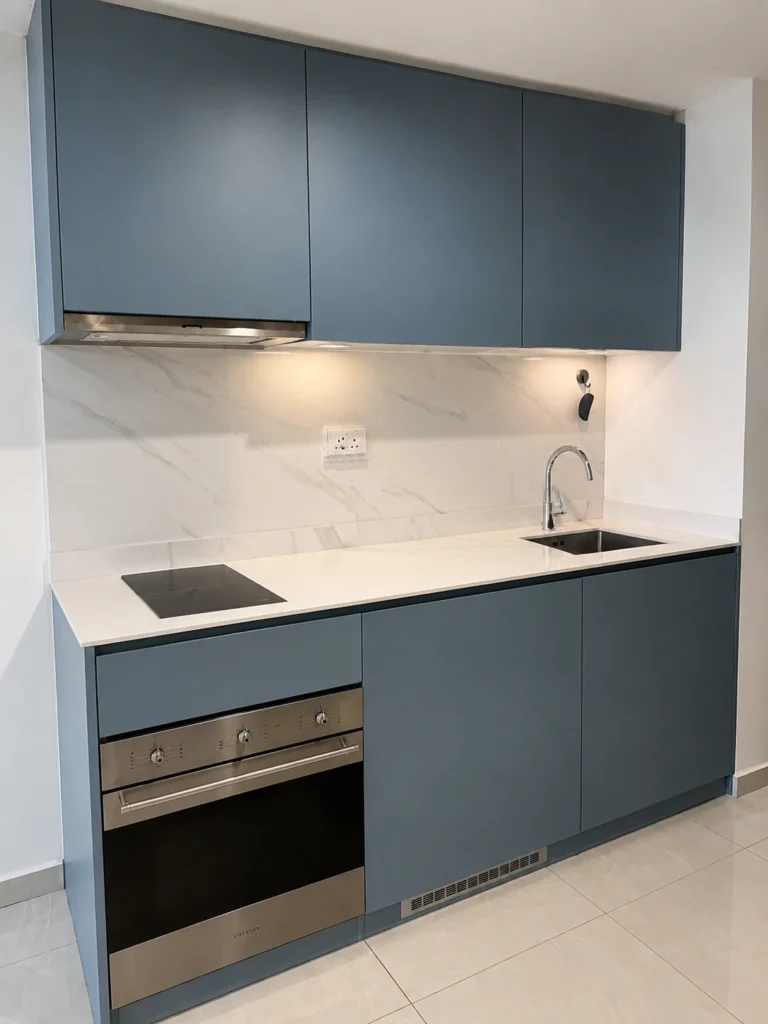
One of the most practical techniques for small kitchens is using two cabinet colours strategically. Lighter upper cabinets keep the visual weight high and the sightlines open, while slightly deeper lower cabinets ground the space without overwhelming it. The colour shift draws the eye upward, emphasising ceiling height.
Matching Your Walls and Ceiling
When cabinet colour blends into the wall colour, the visual break between the two surfaces disappears. This tonal approach, sometimes called a monochromatic scheme, removes the contrasting lines that would otherwise cut the room into smaller sections. It is particularly effective in compact galley layouts, such as those common in HDB flats serviced by kitchen cabinets bedok or other neighbourhoods across the island.
Handling Accents and Hardware
Even in an all-white kitchen, the hardware you select matters. Brushed gold, matt black, or chrome handles in a minimal, flat profile add personality without adding visual clutter. Bulky or heavily ornate handles create extra contrast that can make a small kitchen feel busier than it actually is.
Cabinet Colours That Make a Small Kitchen Look Smaller
Knowing what to avoid is equally useful. Certain colours consistently work against spatial perception in compact kitchens.
Colours to avoid in small kitchen spaces:
- Deep navy or royal blue: Absorbs light aggressively and creates a sense of enclosure.
- Forest or bottle green: Warm, dark greens behave similarly to dark wood tones and compress the perceived ceiling height.
- Terracotta and burnt orange: Warm, mid-to-dark saturates pull surfaces visually inward.
- Charcoal or near-black: Best reserved for large kitchens or single accent elements rather than full cabinet runs.
- Heavy wood stains in walnut or mahogany: The deep reddish-brown tone absorbs light and adds visual weight to every surface it occupies.
These colours are not inherently bad choices in the right context. In an open-plan kitchen with generous ceiling height and multiple light sources, deep navy can look sophisticated. The problem arises when they are used in enclosed, compact spaces with limited natural light.
Colours That Are Looking Dated in 2026
Design cycles move steadily in Singapore’s renovation market. A colour that felt fresh three years ago can now read as tired, particularly in resale-oriented contexts.
Heavily distressed or artificially aged finishes in beige or taupe are losing ground quickly. The mid-2010s trend for heavily greyed, washed-out timber laminates is fading from favour. Similarly, very warm yellow-tinged cream cabinets, which were a staple of the early-2000s HDB renovation, now look noticeably dated next to the cooler, cleaner palettes dominating 2026 design.
If your existing cabinets fall into one of these dated categories and are also showing structural wear, it is worth considering a full replacement rather than a repaint. Cabinets suffering from water damaged kitchen cabinets issues or those with kitchen cabinet peeling laminate problems will not take a new colour evenly and may look worse after refinishing than before.
Applying These Principles in a Singapore HDB Kitchen

Singapore’s standard HDB kitchen presents a specific set of constraints: limited floor area, often a single window or no direct window at all, and finishes that must withstand high humidity, heat from cooking, and occasional water splashing. These conditions shape which colour and material combinations actually work long-term.
Aluminium cabinetry with a high-gloss pale finish is one of the most practical solutions available. It is inherently waterproof, resistant to the swelling and warping that affects wood-based boards in humid conditions, and it holds reflective finishes without degrading over time. T Se7en Alucraft has over 30 years of experience building custom aluminium kitchen cabinets specifically calibrated to Singapore’s residential environments. Their consultants can advise on colour selection, finish type, and layout to maximise the sense of space in any kitchen configuration.
You can reach the T Se7en Alucraft team at +65 9615 9273 or at sales@tse7en.com. WhatsApp consultations and virtual showroom tours are available if you prefer to start the conversation from home.
Lighting as a Multiplier for Cabinet Colour
No cabinet colour works in isolation. The lighting conditions in your kitchen determine whether a pale shade reads as bright and expansive or flat and dull. The practical steps worth taking alongside your colour selection:
- Install under-cabinet strip lighting to illuminate worktops and reduce shadow in lower zones.
- Use warm-white LED sources (around 3,000K) in kitchens with warm-toned cabinets, and neutral-white (around 4,000K) with cool or grey-toned finishes.
- Maximise natural light by keeping window areas clear and using reflective splashback materials in glass or glossy tile.
- Avoid pendant lights positioned so low that they block sightlines across the kitchen.
The interaction between your cabinet colour and your light sources is what ultimately determines the answer to what cabinet colour makes a kitchen look bigger in your specific space. Two identical shade choices can produce very different results depending on whether the room has one small window or full-length glazing.
Key Principles Reviewed
Understanding what cabinet colour makes a kitchen look bigger is fundamentally about working with light rather than against it. Pale, cool, reflective finishes in white, soft grey, or light natural tones consistently outperform dark, saturated colours in terms of spatial perception. The finish matters as much as the colour, and the condition of your existing cabinetry determines whether refinishing or replacement will give you the best result. In Singapore’s compact HDB and condominium kitchens, investing in the right colour and material combination is one of the highest-return changes you can make to how your home feels on a daily basis.
If you are ready to explore your options with a team that understands the specific demands of Singapore kitchens, visit www.tse7en.com or contact T Se7en Alucraft directly to book a consultation and see the full range of aluminium cabinet finishes available for your renovation.
Things to Know
- The finish on your cabinet doors affects spatial perception almost as much as the colour itself; a glossy white will outperform a matte white in a compact kitchen because it reflects significantly more light back into the room.
- Tonal unity between your cabinet colour, wall colour, and ceiling colour is one of the most underused techniques in small Singapore kitchens; removing strong contrast lines between surfaces visually expands the room without requiring any structural changes.
- Natural light direction matters when selecting undertones; a kitchen facing north or with limited windows benefits from cool, bright whites rather than warm creams, which can appear yellowish and heavy under artificial light alone.
- Cabinet condition directly affects how well any colour performs; surfaces with peeling laminate, swollen panels, or water staining will not hold new finishes evenly, meaning colour selection becomes irrelevant if the substrate is compromised.
- Upper cabinet height is a frequently overlooked spatial tool; running cabinets all the way to the ceiling eliminates the visual break at the top, making the room feel taller and less segmented.
- Hardware scale and profile contribute to the overall visual weight of your cabinetry; flat-bar or recessed handles in a tone close to the cabinet colour maintain the clean, uninterrupted surface that helps a small kitchen feel open.
Start Your Kitchen Transformation With the Right Colour Choice
Choosing the wrong cabinet colour in a small kitchen is a costly mistake that affects how your home feels every single day. The right colour, finish, and material combination can make a genuinely significant difference to how spacious and comfortable your kitchen feels, and the team at T Se7en Alucraft has the experience to help you get it right the first time.
With over 30 years of expertise in custom aluminium cabinetry built specifically for Singapore’s climate and living conditions, T Se7en Alucraft designs kitchens that are as practical as they are visually open and refined. Book your appointment today and speak with a consultant who can recommend the ideal colour, finish, and layout for your specific kitchen.
Contact T Se7en Alucraft at +65 9615 9273 or sales@tse7en.com to schedule your WhatsApp consultation or virtual showroom tour and take the first step towards a kitchen that feels genuinely bigger.
The Bottom Line on What Cabinet Colour Makes a Kitchen Look Bigger
The answer is consistent across design expertise, physics, and practical experience in Singapore’s residential spaces: light, cool, reflective colours do the most work. White leads the field, followed by pale grey, soft sage green, and light timber tones, each of which can meaningfully expand the perceived size of a compact kitchen when applied with the right finish and paired with thoughtful lighting.
What cabinet colour makes a kitchen look bigger is ultimately a question about how light behaves in your specific space, and getting the most out of your colour choice means considering the finish, the condition of your existing cabinetry, and the way natural and artificial light moves through the room. If your current cabinets are worn, warped, or carrying a dated finish, no amount of repainting will deliver the result you are after. A full replacement with custom aluminium cabinetry from T Se7en Alucraft gives you a clean, durable, and humidity-resistant foundation that holds reflective finishes beautifully for years to come. Reach out to the T Se7en Alucraft team at +65 9615 9273 or visit www.tse7en.com to start planning your kitchen today.
Frequently Asked Questions
White and bright off-white cabinets are consistently the most effective choice for making a kitchen look bigger.
This is supported by design consensus reported by Homes and Gardens (2022), which identifies white as the top colour for small kitchens due to its reflective, luminous qualities. The high light reflectance of white surfaces bounces both natural and artificial light around the room, visually pushing walls and ceilings outward. Pale grey, soft sage green, and light timber tones are also strong alternatives that achieve a similar spatial effect
Heavily warm-toned creams, yellow-tinged beiges, and mid-2010s greyed timber laminates are the finishes most likely to read as dated in 2026.
The distressed and artificially aged finishes that were popular across Singapore renovation projects roughly a decade ago are now noticeably out of step with the cleaner, cooler palettes dominating current design. Early-2000s HDB staples such as honey-toned wood laminates and warm vanilla cream doors also fall into this category. If your cabinetry carries these finishes alongside structural wear, a full replacement with a contemporary colour is likely to add more value than a surface refinish.
In compact or poorly lit kitchens, deep navy, forest green, charcoal, terracotta, and dark timber stains such as walnut or mahogany should generally be avoided.
These colours absorb light rather than reflect it, which causes surfaces to visually close in around the room and compress the perceived ceiling height. Warm, heavily saturated mid-tones such as burnt orange and rich burgundy carry the same risk. These colours are not inherently poor choices in every context; in a large, well-lit open-plan kitchen they can add sophistication and character. The problem arises specifically when they are applied across full cabinet runs in small, enclosed spaces with limited light sources.
White, soft grey, pale sage green, and light natural timber tones all perform well in small kitchens, with white remaining the benchmark choice.
According to Homes and Gardens (2022), design experts agree that white is the best colour for small kitchens due to its reflective and luminous qualities. Beyond white, the principle to follow is that lighter, cooler, and less saturated tones consistently outperform darker or warmer alternatives in confined spaces. Pairing light upper cabinets with a slightly deeper lower cabinet tone adds depth and interest without sacrificing the open feeling that pale colours create. Finish type also plays a role; a satin or semi-gloss finish in any of these colours will outperform a matte finish in terms of light reflectance.
Light, cool, and reflective colours make a small kitchen look bigger, with white, pale grey, soft blue, and light natural timber tones leading the list.
The physics behind this is grounded in how surfaces interact with light. As noted by Mars Brothers Kitchen and Bath (July 2026), referencing NIST research on surface reflectance values, the more light a surface bounces back into a room, the larger and more open that room feels. Beyond cabinet colour alone, applying the same pale tone to walls and ceilings removes the contrasting lines that visually divide a room into smaller sections. Combining this tonal approach with under-cabinet lighting, reflective splashback materials, and minimal hardware creates a layered effect that makes the most of every square metre in a compact Singapore kitchen.
Still Unsure?
Speak to a professional now and get personalized consultation and guidance for your next renovation. Work with a team you can trust!
Best Materials for Kitchen Cabinets in Singapore
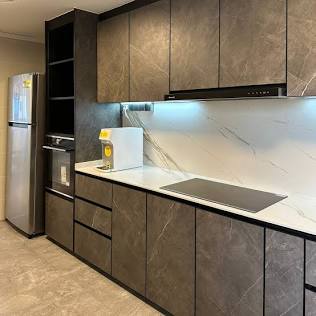
Home Blog Aluminium cabinets offer superior moisture resistance and a lifespan exceeding 20 years, making them particularly well-suited to Singapore’s humid tropical climate. Plywood cabinets,...
One Response