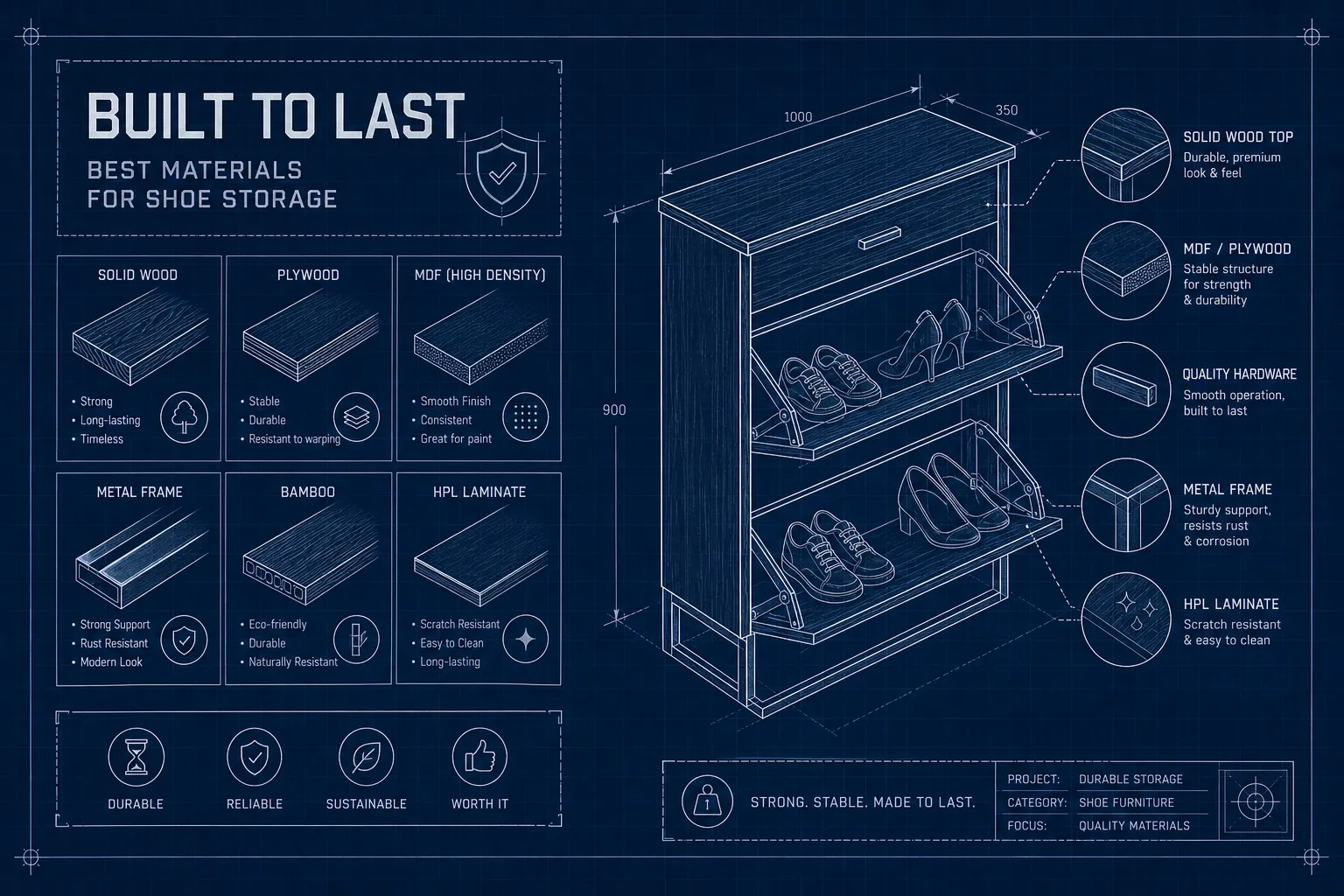
What are the best materials for durable shoe storage furniture? In Singapore’s humid climate, the answer matters more than most people realise. Picture this: you bought a decent-looking shoe cabinet two years ago, thought it was a solid purchase, and now the shelves are sagging under the weight of a few pairs of sneakers, the laminate edges are bubbling, and one door refuses to close properly. That’s not bad luck. That’s what happens when the wrong material meets Singapore’s humidity, and it plays out in thousands of HDB entryways every year.
Choosing the right material for shoe storage is a straightforward decision once you know what to look for. This guide breaks down the most common options honestly, compares them on moisture resistance, load capacity, and realistic lifespan, and gives you a clear framework for making a decision that actually holds up. Whether you’re buying off the shelf or commissioning a built-in solution with a specialist like T Se7en Alucraft, the material choice determines everything.
Shoe storage sits at the most exposed point in your home. Every time your front door opens, humidity floods in. Wet footwear drops moisture directly onto shelves. In high-floor or coastal blocks, salt-laden air adds another layer of stress. Unlike a bedroom wardrobe tucked into a dry interior room, your entryway shoe cabinet faces real environmental punishment every single day.
Before comparing materials, anchor your evaluation on three factors: moisture resistance (how the core and surface react to sustained humidity and wet shoes), structural strength (whether shelves hold up under the weight of multiple pairs without sagging), and surface durability (whether the finish resists scuffs, peeling, and mould over time). Price matters too, but a cheap cabinet that fails in three years costs more in the long run than a more expensive one built to last fifteen.
Material is only one part of choosing the right storage solution. The cabinet design and dimensions matter just as much, especially in compact Singapore homes where entryway space is limited. This guide on choosing the best shoe cabinets for small entryways explains how factors like cabinet depth, ventilation, and layout affect everyday usability.
With indoor humidity averaging around 80% to 84% in Singapore HDB flats, and climbing higher in low-floor units where ground-level evaporation adds 3 to 6% more moisture, the degradation timeline for common materials is faster than most buyers realise. MDF can show permanent swelling at unsealed edges quickly once moisture exposure begins. Particleboard absorbs moisture to a point where joints weaken and drawer bases collapse within two to three years. Even MR-Grade plywood, once its surface finish is chipped or worn, begins absorbing humidity at exposed points. Metals such as aluminium and stainless steel remain dimensionally stable compared with hygroscopic wood-based materials, regardless of what ambient humidity is doing on any given day. For a concise primer on how indoor humidity affects health and homes, see this resource on indoor humidity.
For those in coastal areas, including parts of Bedok, Pasir Ris, Sentosa, and the West Coast, salt-laden air adds a further dimension. Salt accelerates corrosion in exposed metal hardware and penetrates unsealed wood edges faster than standard humidity alone. Even the screws and cam locks inside a particleboard or MDF cabinet can rust, making drawers progressively harder to operate. Aluminium paired with corrosion-resistant hardware holds up in coastal conditions that would shorten the lifespan of wood-based furniture by years.
Many ready-made shoe cabinets use some form of engineered wood. The differences between these options are significant, and the wrong choice will show its weaknesses within months in a tropical interior. For a side-by-side comparison of plywood, MDF and particleboard that explains how each core reacts to moisture and loading, read this plywood vs MDF vs particle board comparison.
MDF (Medium-Density Fiberboard) is popular because it takes laminate and paint beautifully, producing that clean, uniform finish seen in most flat-pack furniture. The problem is that MDF is highly sensitive to moisture. When edges are unsealed, the material swells permanently and never recovers. A well-sealed, melamine-coated MDF cabinet can last 5 to 10 years, but it demands careful handling and zero water contact at joints and edges. For further reading on the practical differences between MDF and particleboard in furniture, see this overview on particleboard vs MDF.
Plywood is a different story altogether. Its cross-grain construction resists warping significantly better than MDF, holds screws and hardware more securely, and handles humidity with considerably more competence when MR (Moisture-Resistant) Grade plywood is specified. Lifespan estimates for plywood shoe cabinets sit at 15 to 30 years, which puts it in a completely different tier from MDF. It costs more upfront, but the durability gap justifies the investment for any long-term installation.
Particleboard is the one material to avoid outright. Its structural strength is roughly 25% of plywood, its screw-holding is poor, and in humid conditions it swells, sags, and crumbles within two to three years. Many entry-level flat-pack shoe racks use particleboard to keep costs down. If a product listing doesn’t clearly state MDF or plywood, ask the seller directly, many low-cost listings omit material specifications and may well be using particleboard. For shoe storage in Singapore’s climate, it simply isn’t worth considering.
Solid wood carries genuine appeal. Oak, walnut, and beech can last 20 to 30 years or longer with proper care, and unlike engineered panels, solid wood can be sanded, refinished, and repaired. The challenge in Singapore is that solid wood is hygroscopic: it expands in high humidity and contracts when conditions dry out. Without proper sealing and engineered construction, panels can warp, drawers can stick, and joints can loosen over time. Solid wood is an excellent choice when it’s properly treated and sealed from the outset, but it isn’t a forgiving material in a tropical climate without that preparation.
Strand-woven bamboo offers genuine hardness and dent resistance, often outperforming softer wood species, with a clean aesthetic that works well in modern HDB interiors. The limitation is that bamboo furniture is an engineered product held together with adhesives. In sustained high humidity, the adhesive bonds can weaken over time, leading to delamination. For a shoe rack in a well-ventilated entryway, bamboo performs adequately. In a corridor that traps humidity, that glue-dependent construction becomes a genuine liability.
Aluminium doesn’t rust, doesn’t swell, and doesn’t absorb moisture. Its corrosion resistance is built into the metal’s composition rather than reliant on a surface coating remaining intact the way powder-coated steel is. An aluminium frame or cabinet panel in Singapore’s humidity generally remains dimensionally stable and corrosion-resistant over decades, though it can develop surface oxidation or sustain dents over time, these do not compromise structural integrity the way wood swelling or rust does. It’s lightweight relative to steel, making it practical for cabinetry applications, and it can be anodised or powder-coated to achieve any finish aesthetic you want. For a deeper look at aluminium cabinet options in a Singapore context, check out this guide on aluminium cabinet materials in Singapore.
This matters specifically in powder-coated steel comparisons. Steel is harder and more impact-resistant, but if the coating is scratched or chipped by a wet boot or a dropped umbrella, moisture enters and corrosion begins underneath. Aluminium, even with a damaged finish, won’t rust. For environments where moisture is a constant feature, entryways, bathrooms, kitchens, and homes in coastal areas, aluminium simply outlasts every other option without the vulnerability that coating-dependent materials carry. For a technical comparison, see this analysis of powder-coated steel vs aluminium.
Most homeowners associate aluminium cabinetry with wet kitchens, but the same properties apply directly to entryway storage. T Se7en Alucraft designs and fabricates custom aluminium cabinetry for Singapore homes, regularly extending that expertise beyond the kitchen to entryway and living spaces. A custom aluminium shoe cabinet built to your entryway’s exact dimensions, fitted with soft-close doors and internal compartments sized for different shoe types, delivers storage that no flat-pack alternative can match over a ten-year horizon. For more on why aluminium cabinets are becoming popular in local homes, read why aluminium kitchen cabinets win in Singapore homes. For HDB and BTO homeowners planning a full renovation, it’s worth including entryway storage in the brief from the start.
Before committing to any shoe storage solution, run through these three checks:
Here’s a quick material reference before you decide:
If your entryway has an awkward dimension, a shared wall with a bathroom, or faces a window that lets in rain-driven humidity, a custom-built solution is almost always more cost-effective over a ten-year horizon than replacing a flat-pack cabinet every three to five years. Custom aluminium shoe cabinets in Singapore typically range from $660 to over $1,400 depending on configuration. That upfront investment looks very different when you compare it to replacing a $200 particleboard unit multiple times across the same period.
For homeowners dealing with unusual layouts or wanting storage built around their exact entryway dimensions, custom shoe cabinet solutions in Singapore can provide more flexibility than standard retail units. Custom designs allow materials, ventilation, shelving height, and cabinet depth to be adjusted based on how the space is actually used.
Choosing the right material for shoe storage isn’t a minor detail. It’s the decision that determines whether your cabinet is still functioning well in a decade or has already been replaced twice. In Singapore’s humid climate, particleboard fails first, standard MDF follows without careful maintenance, and even solid wood requires proper sealing and treatment to stay stable. Aluminium stands apart because its corrosion resistance is built into the metal’s composition rather than reliant on any coating staying perfect.
If you’re planning a renovation or fitting out a new BTO or HDB unit, include entryway storage in your brief alongside the kitchen and bathroom work. For guidance on selecting materials for wet-adjacent areas like bathrooms, consult this piece on best bathroom cabinet materials. Knowing what are the best materials for durable shoe storage furniture comes down to matching material to environment. In Singapore, that almost always means aluminium or well-specified MR-Grade plywood, installed by someone who understands both the material and the climate it needs to perform in.
T Se7en Alucraft offers consultations for homeowners exploring custom aluminium entryway solutions. One conversation is usually enough to understand what’s possible, what it costs, and whether it makes sense for your space. Get in touch to discuss your entryway storage options.
The best material for shoe storage furniture in Singapore’s humid climate is aluminium, followed by MR-Grade plywood. Aluminium performs best because it does not absorb moisture, swell, warp, or rust like wood-based materials. MR-Grade plywood is also a reliable option when properly sealed, but aluminium offers superior long-term durability for humid entryways and coastal homes.
Singapore’s high humidity, frequent rain, and moisture from wet footwear can damage many common cabinet materials. Particleboard often fails within a few years, while MDF requires careful sealing to prevent swelling. Aluminium cabinets remain dimensionally stable and are especially suitable for HDB entrances, bathrooms, and moisture-prone areas.
Plywood is generally better than MDF for shoe cabinets in Singapore because it has stronger screw-holding ability, better resistance to humidity, and a longer expected lifespan. MR-Grade plywood can last around 15 to 30 years when properly finished, while MDF typically lasts 5 to 10 years with careful maintenance.
MDF is popular because it provides a smooth surface for laminates and paint finishes, but exposed edges can absorb moisture and permanently swell. Plywood’s cross-layer construction makes it more stable in tropical conditions where humidity levels remain high throughout the year.
Homeowners should avoid particleboard shoe cabinets in Singapore because particleboard has poor moisture resistance, weak screw-holding strength, and can swell or crumble when exposed to humidity. Many low-cost shoe cabinets fail within two to three years because of particleboard’s vulnerability to moisture.
Particleboard is made from compressed wood particles held together with adhesives. When moisture enters through damaged edges or joints, the material loses structural strength, causing sagging shelves, loose hinges, and cabinet failures. For long-term shoe storage, stronger materials such as aluminium or MR-Grade plywood are better investments.
An aluminium shoe cabinet can last 50 years or more in typical applications, making it significantly more durable than most wooden shoe cabinets. Aluminium does not absorb moisture, swell, or suffer from the same humidity-related failures that affect MDF, particleboard, and untreated wood.
Wood-based cabinets can still perform well when high-quality materials and proper sealing are used. However, aluminium provides a stronger advantage in Singapore because its corrosion resistance is built into the material rather than depending only on protective coatings.
When buying a durable shoe storage cabinet, check the core material, construction quality, and moisture protection. The best choices are aluminium cabinets or MR-Grade plywood cabinets with sealed edges, strong joints, and finishes designed for humid environments.
A practical checklist includes:
Speak to a professional now and get personalized consultation and guidance for your next renovation. Work with a team you can trust!
Home Blog HIP is HDB’s upgrading programme for older flats. It covers compulsory repairs such as concrete defects and ageing waste pipes at a very...