


T Se7en Alucraft designs, fabricates and installs custom kitchen cabinets for HDB flats, BTOs, condominiums and landed homes across Singapore, in aluminium, laminate and stainless steel. Every kitchen is measured on site, built at our Woodlands workshop and installed by our own team, usually 2–6 weeks from measurement.
Choosing kitchen cabinets in Singapore comes down to four things: moisture exposure, kitchen layout, storage needs and construction quality. Aluminium and stainless steel perform well in wet areas, while laminated plywood offers more design choice when it is properly sealed. This page explains the main materials, layouts, styles, fittings and planning decisions, and what to compare in a quotation.
At a glance • Price: from $200-$700 per foot run for top and bottom cabinets (Oct 2026) • Lead time: 2–36 weeks fabrication; 1–10 days installation • Warranty: typically 5–10 years, up to lifetime, depending on materials and panels chosen • Experience: 30+ years in the interior field · 549+ happy customers in Singapore • HDB: parent company CONCEPCION INTERIORS PTE LTD, HDB Directory of Renovation Contractors ref. HB-05-3488E |
Key Takeaways
- Choose cabinet materials by moisture exposure, daily use and maintenance, not appearance alone.
- Aluminium and stainless steel suit moisture-prone areas; laminated plywood gives more design flexibility.
- Performance also depends on joints, hardware, sealants, installation and plumbing conditions.
- HDB and BTO cabinets should be designed from actual site measurements, not assumed standard sizes.
- Compare quotations by materials, hardware, scope, exclusions and warranty, not only price.
- Get materials, fittings, timelines, payment stages and warranty terms in writing before work starts.
What Are the Main Kitchen Cabinet Materials in Singapore?
The most common kitchen cabinet materials in Singapore are aluminium, stainless steel, laminated plywood, MDF and particle board. They differ in moisture resistance, appearance, maintenance and design flexibility, so the right choice depends on where the cabinet sits and how much water, steam and heat it faces.
Material | Best suited for | Main advantages | Main considerations |
Aluminium | Wet kitchens, sink areas, low-maintenance households | Does not absorb water, termite-resistant, easy to clean | Fabrication quality, joints, finishes and hardware vary between suppliers |
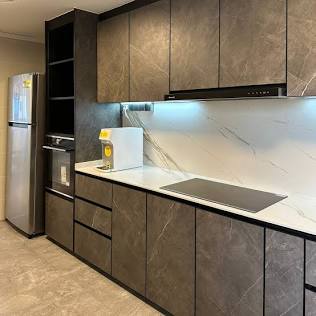
Stainless steel | Heavy-use or semi-commercial kitchens | Strong moisture, heat and corrosion resistance; grades 304, 316 and 430 | More industrial look; scratches and fingerprints show |
Laminated plywood | General kitchens with varied design needs | Wide range of colours, textures and door styles | Exposed edges and damaged laminate need protecting from moisture |
MDF | Decorative doors, lower-moisture areas | Smooth surface, many finishes | Can swell if water reaches the core |
Particle board | Dry areas, tight budgets | Affordable, many finishes | Not suited to prolonged moisture |
No cabinet should be judged by the carcass material alone. Door construction, joints, sealants, hinges, drawer runners, workmanship and plumbing conditions all affect how long it lasts.
Is Aluminium a Good Fit for Your Kitchen?
Aluminium doesn’t absorb water the way wood-based boards do, which makes it practical near sinks, dishwashers and other wet areas. Whether it suits your kitchen still depends on layout, budget and how well the system is fabricated and installed. See our aluminium kitchen cabinets for how we build them and the trade-offs to know before choosing.
Is Plywood Suitable for Kitchen Cabinets?
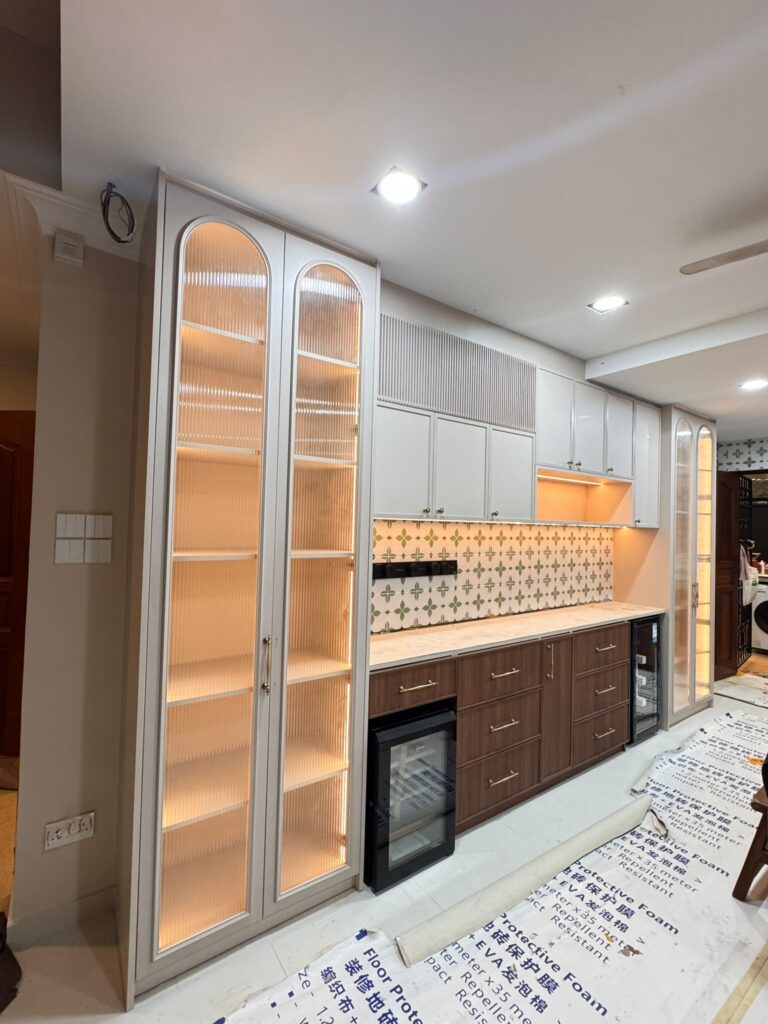
Laminated plywood stays popular for its range of colours, textures and door designs. Its performance depends on the plywood grade, laminate quality, edge sealing and workmanship. Watch sink cabinets, floor-level cabinets and exposed edges: moisture usually gets in through damage, unsealed openings, plumbing leaks or poorly protected joints, not through an intact laminate face.
What About MDF and Particle Board?
Both give smooth finishes at accessible prices but need more protection from water, so they are better in dry sections than near sinks or pipes. Ask your contractor to name the exact board type rather than calling everything “wood”, and to state where each material is used.
Stainless steel kitchen cabinets
Stainless steel is waterproof, hygienic and easy to clean, which is why it suits commercial and heavy-use kitchens. Grade 304 is standard for homes, 316 is marine-grade for the harshest conditions and 430 is the budget option. Compare the grades in our stainless steel kitchen cabinets guide.
Built-in, modular or ready-made kitchen cabinets?
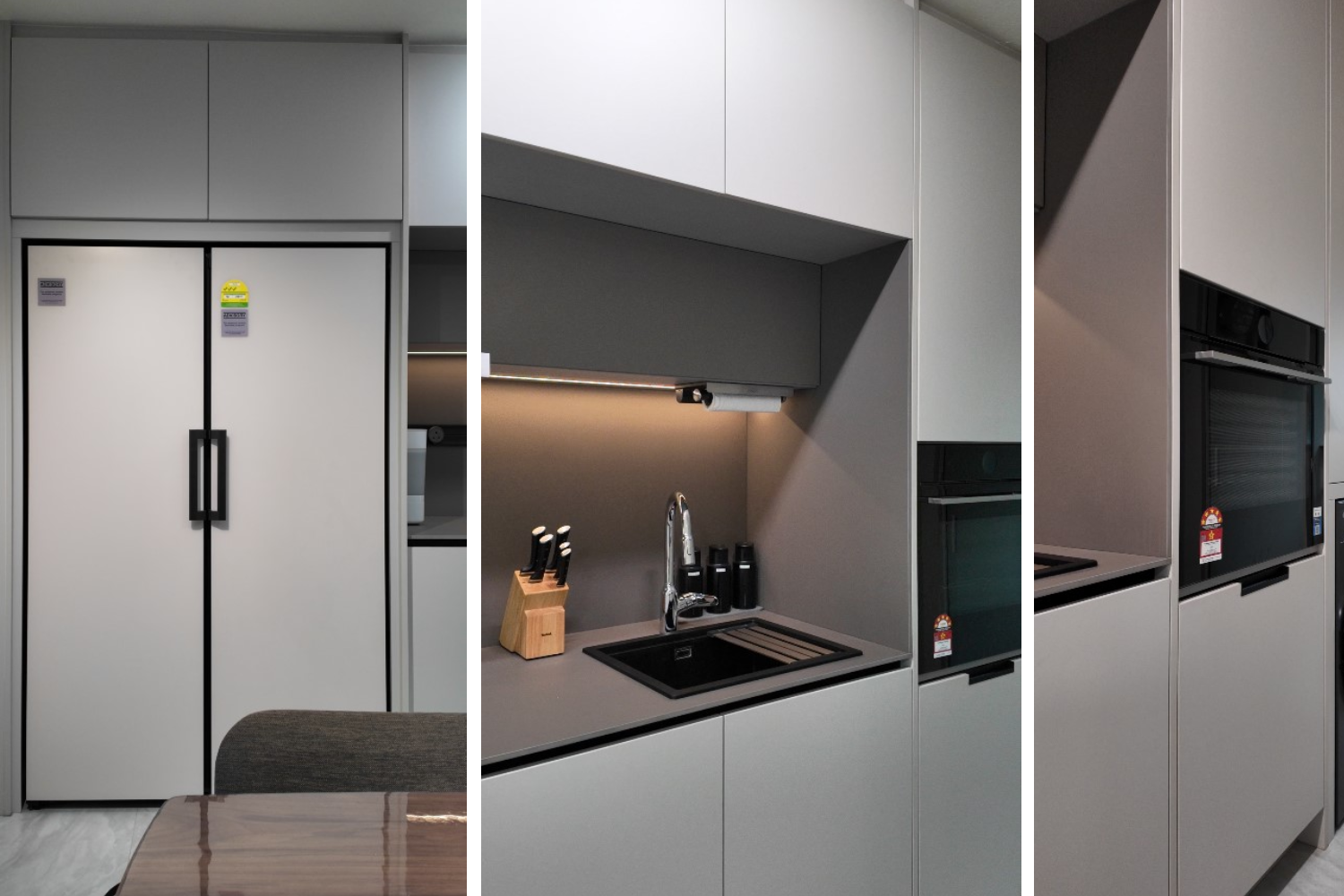
Modular cabinets use preset sizes; built-in (custom) cabinets are measured and made for one room; ready-made cabinets are bought off the shelf. Modular systems are quicker to plan, while built-in cabinets fit uneven walls, narrow clearances, odd corners and specific storage needs better.
Factor | Modular | Built-in / custom |
Configuration | Preset sizes or modules | Built around the actual kitchen |
Planning time | Usually simpler | Needs detailed measurement and design |
Layout flexibility | More limited | High |
Finish options | Depends on the system | Usually broader |
Difficult corners | May need fillers or compromises | Designed around the space |
Future replacement | Single modules easier to swap | Depends on the original design and maker |
Modular cabinets suit straightforward layouts with standard appliance positions; built-in cabinets suit irregular rooms. Compare modular vs custom kitchen cabinets, or see what’s available as ready-made kitchen cabinets.
Kitchen cabinets for HDB, condo and landed homes
Home type | What usually matters | Our usual recommendation |
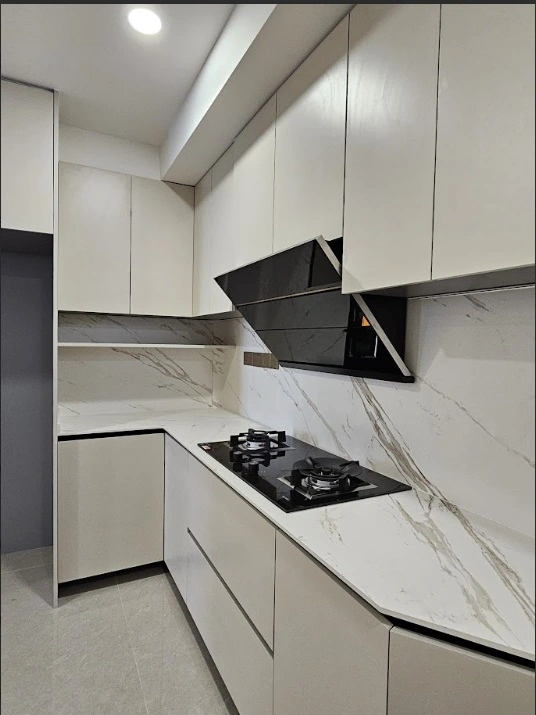
HDB and BTO | Compact space, ventilation, sink and service-yard access | Moisture-resistant carcass, full-height wall cabinets, deep drawers; compare ready-made vs built-in for budget |
Condo | Matching the interior design, built-in appliances | Soft-close hardware, integrated lighting, built-in oven and fridge housing |
Landed | Larger layouts, separate wet and dry kitchens | Stainless steel or aluminium in the wet kitchen; finish-led cabinets in the dry kitchen |
Planning HDB and BTO kitchens
Design from the actual room, not assumed standard sizes: flat type, building age, previous renovations, wall conditions and service points all change the usable layout. Check walkway width, clearance between opposite counters, sink and pipe positions, cooker and hood placement, appliance clearances, and access to windows, the service-yard door and power points. Measure every appliance, including room for ventilation, plugs, hoses and door swing.
Narrow kitchens need storage that doesn’t block safe movement, for example avoiding deep cabinets on both sides of a tight walkway; see our small HDB kitchen layout ideas. Standard sizes are in our kitchen cabinet dimensions for HDB guide, and new-flat owners can start with our BTO kitchen cabinets page or HDB kitchen cabinets by flat type.
Kitchen cabinet layouts and styles
Layout usually affects how convenient a kitchen feels more than colour or door design. Common layouts in Singapore are straight, L-shaped kitchen cabinets, U-shaped, galley and island kitchens; add an island only if there is enough clearance around it (kitchen island costs and sizes).
Popular styles include modern flat-panel and handleless designs, traditional framed doors, curved kitchen cabinets for softer edges, and grey and other trending cabinet colours. Powder-coated finishes give durable solid colours. Browse kitchen cabinet design ideas for more.
Should upper cabinets reach the ceiling?
Full-height upper cabinets (typically 2.4–2.6 m) add storage and leave no top surface for dust, but the highest shelves are hard to reach and best kept for things you rarely use. Shorter uppers make a small kitchen feel more open but store less. Decide by ceiling height, reach, ventilation and whether services or access panels sit above the cabinets.
Are handleless cabinets practical?
Recessed handle profiles are usually easier to use than push-to-open systems, especially with wet or full hands. Test the mechanism and ask how easily it can be adjusted or replaced.
Pantry cabinets and tall storage
A tall pantry cabinet is the most efficient storage in a small kitchen: one floor-to-ceiling unit with pull-out shelves holds dry goods, small appliances and cleaning items without using counter space. Other options that work in Singapore kitchens:
- Wall-mounted cabinets above the counter for daily items and spices
- Under-counter drawers for utensils and small appliances
- Corner units (Lazy Susan, magic corner pull-outs) for space that is usually wasted
- Pull-out shelving for pots and pans in deep base cabinets
- Hidden storage: toe-kick drawers, behind-door spice racks and ventilated appliance garages
For wall units in compact 3-room kitchens, keep the depth to about 550mm to 600mm
Kitchen cabinets and countertops
Cabinets and countertops are usually quoted together, and the top affects the cabinet design: heavier stone needs stronger base support, and sink and hob cut-outs must be planned before fabrication. Common choices are quartz, sintered stone, solid surface and stainless steel. Compare them in our kitchen countertop materials guide.
Doors, hardware and fittings
Hinges, drawer runners, handles and internal fittings decide how smoothly doors open, how much weight drawers carry and how organised the kitchen stays. A premium-looking cabinet is still frustrating with poor hardware, so ask for the brand or specification in the quotation rather than “premium hinges”. We commonly fit Blum, HiGold, KKPL, Ecoware and Hettich, with soft-close as standard.
See our kitchen cabinet hardware and accessories checklist, compare kitchen cabinet door types, and plan the dish rack cabinet where it can drain safely and be removed for cleaning.
How is a kitchen cabinet project planned and installed?
Measurement should cover more than wall length: walls, floors and ceilings are rarely level, and pipes, beams, windows, sockets and appliances reduce usable space. Where old cabinets hide the walls, measurements should be confirmed after demolition.
- Site visit: measure, check plumbing and power points, discuss how you cook and store
- Design and quote: layout drawing, 3D view, finish and hardware options, itemised quote
- Fabrication: cut, assembled and checked at our workshop, 2–6 weeks
- Installation: 1–10 days on site, doors and drawers aligned, handover
Step-by-step details are in our kitchen cabinet installation process. You can also see finishes in person at our kitchen cabinet showroom.
Recent kitchen cabinet projects
- Keat Hong, HDB resale: 4 m straight kitchen with laminate finish, space for a future oven and microwave, full access to the service yard. 2 weeks.
- Tampines, landed home: 10 m U-shaped kitchen with tall larder and dishwasher; top cabinets with tinted glass frames set at a reachable height under a 3 m ceiling. 6 weeks.
- Serangoon, BTO: 5 m straight kitchen with two-tier top cabinets and a base bay for the cat’s food and water. 4 weeks.
More photos are in our project gallery.
How to compare kitchen cabinet quotations
Compare by specification and scope, not only the total. A complete quotation names the carcass and door materials, panel thickness, internal fittings, hardware, countertop and backsplash, sink and appliance cut-outs, demolition and disposal, timeline, payment schedule, and product and workmanship warranties. Don’t rely on verbal promises about waterproofing, hardware brands, completion dates or warranty; get them in writing.
Before you appoint anyone, use our kitchen cabinet quotation checklist and our guide to choosing a kitchen cabinet contractor.
Are kitchen cabinets really waterproof?
A cabinet can use a water-resistant material without the whole system being waterproof. Water still gets in through joints, cut-outs, damaged seals, hardware holes and poorly finished edges, and leaks can damage walls, floors and countertops around a cabinet that holds up. Ask which parts a waterproof claim covers and whether it is in the warranty; see how we build waterproof kitchen cabinets.
Why do kitchen cabinets fail early?
Usually a mix of material choice, workmanship, installation and use: plumbing leaks, unsealed edges, misaligned doors and overloaded or corroded hardware are the most common causes. Sagging doors, stiff drawers and swelling near the sink should be checked early, before nearby panels are affected. Read common kitchen cabinet problems and how to avoid them.
Cleaning and maintenance
Use a soft cloth and a mild cleaner suited to the finish, don’t leave standing water around joints, hinges, handles and countertop edges, and fix damaged seals or edges quickly. See how to clean kitchen cabinets for material-specific steps.
What should a kitchen cabinet warranty cover?
It should separate product coverage from workmanship coverage, list which components are covered and for how long, and state exclusions such as plumbing leaks, misuse, overloading or unauthorised changes. Ours typically runs 5–10 years, and up to lifetime, depending on the materials and panels you choose.
Related storage
If finishes or sightlines need to match, plan feature storage with the kitchen: display cabinets, aluminium wardrobes and shoe cabinets can use the same materials and colours.
Get a quote
Send us your floor plan or a photo of your kitchen and your flat type. We’ll reply with an itemised quote and arrange a free site visit.
WhatsApp +65 9750 9275
Contact us · 39 Woodlands Close, #05-21, Singapore 737856
FOLLOW US ON SOCIAL MEDIA:
Start with where the cabinet sits. Near the sink, dishwasher or in a wet kitchen, choose aluminium or stainless steel. In dry areas, laminated plywood gives more colour and texture choice. Then compare hardware, edge sealing and warranty, not just the board name.
Aluminium and stainless steel, because neither absorbs water, so they won’t swell, warp or delaminate. Laminated plywood can work well if edges are sealed and it is kept away from leaks; MDF and particle board are best kept to dry areas.
Modular cabinets come in preset sizes and are quicker to plan; custom (built-in) cabinets are measured and made for your room, so they handle uneven walls, corners and appliances better. Modular modules are easier to swap later.
Our cabinets start from $200-$700$ per foot run for top and bottom cabinets. A typical 8–10 ft HDB kitchen costs about S$5,000-S$25,000 depending on layout, tall units, fittings, finish and countertop.
Carcass and door materials, panel thickness, hardware brand, internal fittings, countertop and backsplash, cut-outs, demolition and disposal, timeline, payment stages, and separate product and workmanship warranties.
It depends on material and care. Water-resistant materials like aluminium, with good hardware and no plumbing leaks, last longest; wood-based boards near the sink are usually the first to fail. Our warranties typically run 5–10 years, up to lifetime depending on materials.
Use full-height wall cabinets, deep drawers instead of shelves, a tall pantry unit, and corner pull-outs. Keep at least one side of a narrow walkway shallow so you can still move safely.
Yes if your kitchen has straight walls and standard appliance positions. If it has pipes, beams, odd corners or a narrow walkway, built-in cabinets usually make better use of the space.
Still Unsure?
Speak to a professional now and get personalized consultation and guidance for your next renovation. Work with a team you can trust!
Best Materials for Kitchen Cabinets in Singapore
Home Blog HIP is HDB’s upgrading programme for older flats. It covers compulsory repairs such as concrete defects and ageing waste pipes at a very...